
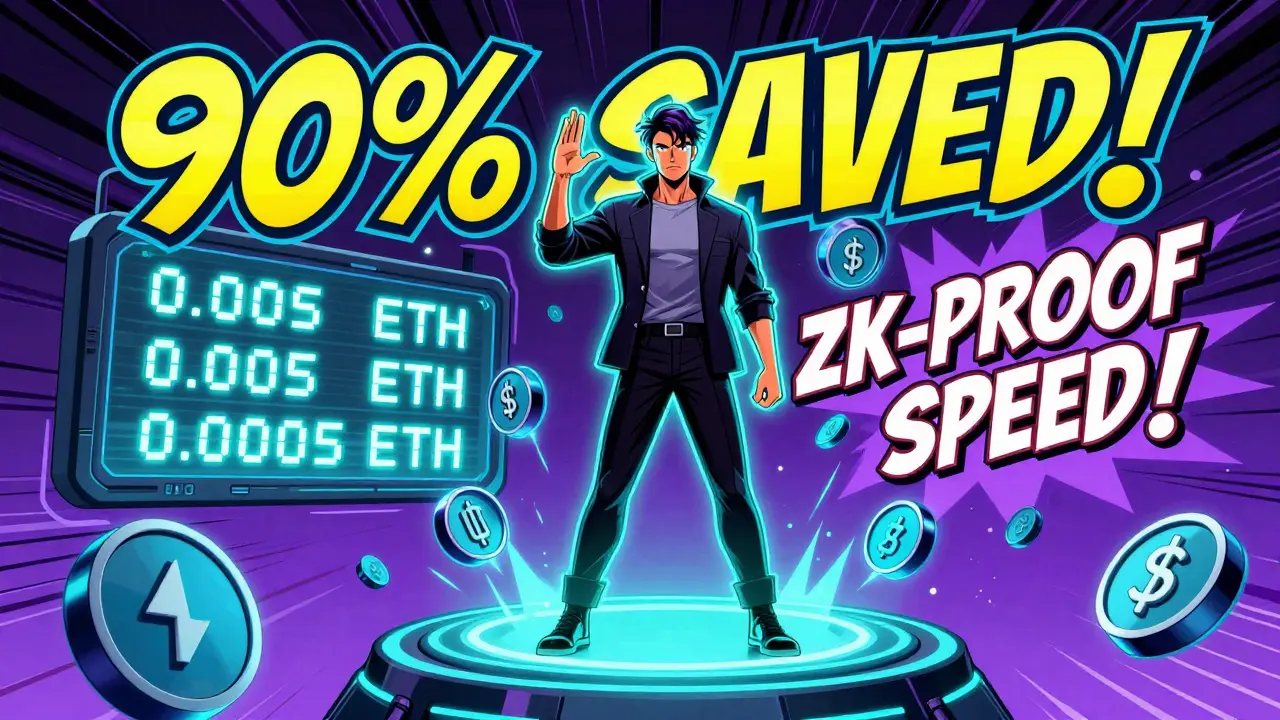
When you’re trading crypto on Starknet, you don’t want to pay $10 in gas fees just to swap ETH for USDC. That’s why mySwap exists - and why it’s become one of the most used decentralized exchanges on the network. Built specifically for Starknet, mySwap cuts costs, speeds up trades, and keeps your funds in your wallet. No middleman. No custodial risk. Just direct, efficient swaps powered by zero-knowledge proofs.
What Makes mySwap Different?
Most DEXs like Uniswap use a constant product model. That means liquidity is spread evenly across all price ranges. The problem? Most of that money sits idle. If ETH trades between $2,800 and $3,000, but your liquidity is spread from $1,000 to $5,000, you’re wasting 80% of your capital. mySwap fixes that with concentrated liquidity - a model borrowed from Uniswap v3 but optimized for Starknet’s zk-Rollup tech. Instead of spreading your funds thin, you pick a price range - say $2,750 to $3,050 - and put all your liquidity there. When trades happen within that range, you earn fees. Outside it? You earn nothing. Sounds risky? It is - but mySwap’s tools make it easy. The platform gives you auto-strategy templates, real-time range suggestions, and a one-click rebalance button. You don’t need to be a math wizard to optimize your position.How it Works: Starknet’s Secret Sauce
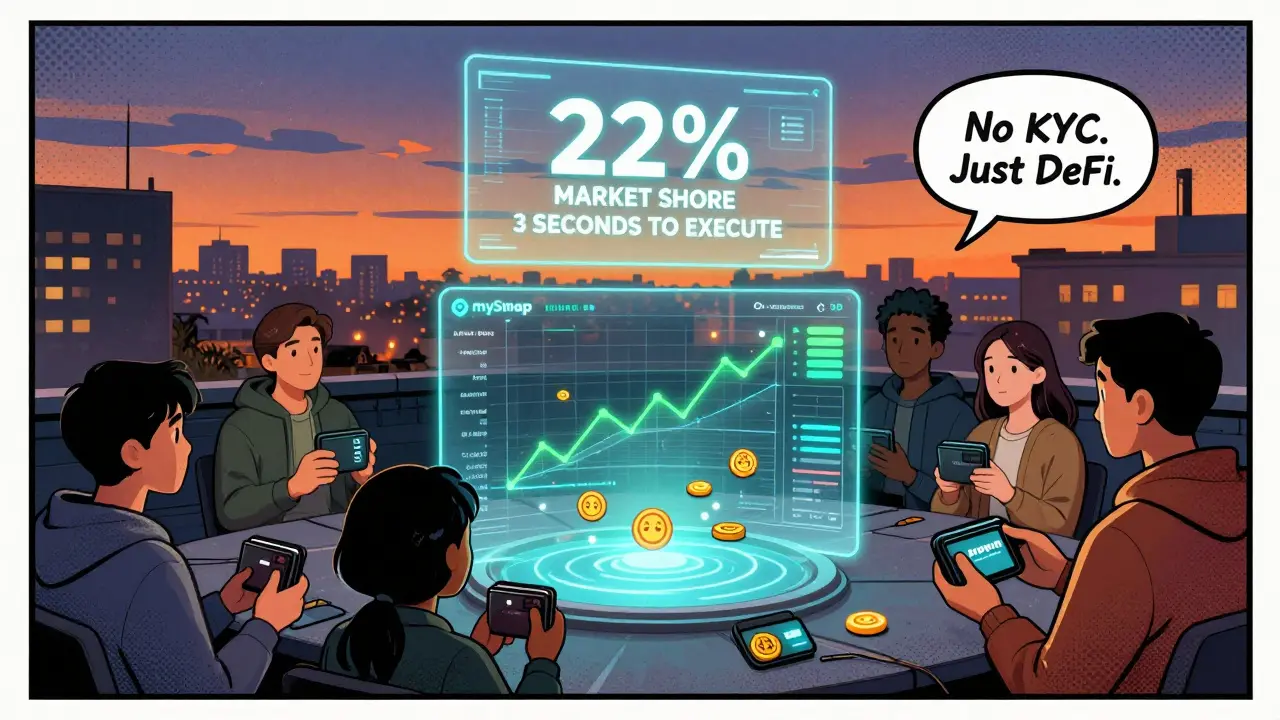
Starknet isn’t just another Layer 2. It uses zk-Rollups with zero-knowledge proofs. That means transactions are batched off-chain, verified cryptographically, and then posted to Ethereum as a single proof. The result? Near-instant settlement and fees that are 90% lower than Ethereum mainnet. mySwap leans into this. Every swap you make on mySwap uses Cairo - Starknet’s native programming language - to execute smart contracts with minimal overhead. Because of this, the average gas cost for a swap is around 0.0005 ETH. Compare that to Uniswap on Ethereum, where a simple trade can cost 0.005 ETH or more. That’s a 90% saving right there. Plus, mySwap integrates with Chainlink for accurate price feeds and works with Argent and Braavos wallets. You don’t need to juggle multiple apps. Connect your wallet, deposit your tokens, and start trading. No KYC. No sign-up forms. Just pure DeFi.Trading Pairs and Liquidity
As of early 2026, mySwap supports 6 core tokens and 16 trading pairs. The list includes ETH, USDC, STRK, DAI, WBTC, and STARK. That’s not a lot compared to Uniswap’s 10,000+ pairs - but it’s intentional. mySwap isn’t trying to be everything. It’s focused on the most traded assets in the Starknet ecosystem. This narrow focus has benefits. Deeper liquidity for each pair. Lower slippage. Faster execution. In tests, average trade execution time is under 3 seconds. For users doing frequent swaps - like yield farmers or traders moving between assets - that’s a game-changer. The downside? If you want to trade a new altcoin that’s only listed on JediSwap or ZKasino, you’re out of luck. mySwap doesn’t list obscure tokens. It’s not designed for speculation. It’s built for stability and efficiency within the Starknet core.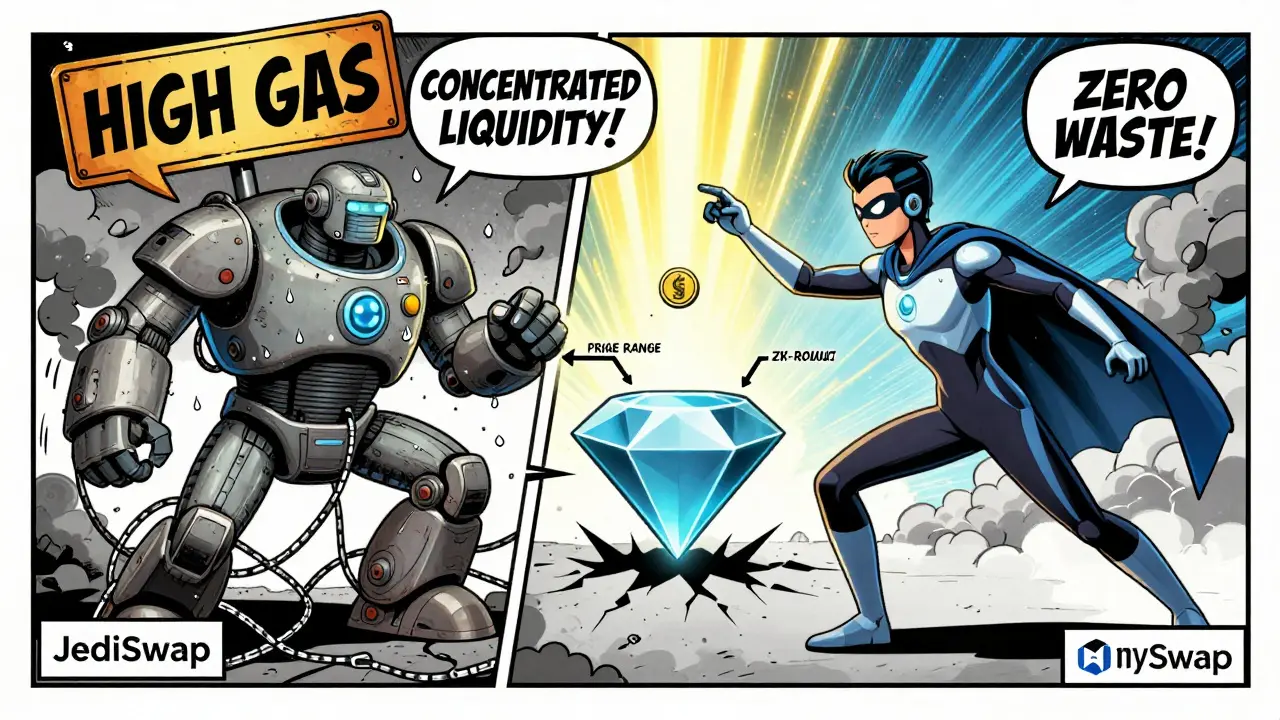
Cost Comparison: mySwap vs. Other Starknet DEXs
| Feature | mySwap | JediSwap | ZKasino |
|---|---|---|---|
| Trading Pairs | 16 | 28 | 12 |
| Avg. Gas Cost per Swap | 0.0005 ETH | 0.0007 ETH | 0.0008 ETH |
| Concentrated Liquidity | Yes | No | Yes |
| One-Click Rebalance | Yes | No | Partial |
| User Ratings (Slashdot) | 4.3/5 (51 reviews) | 3.9/5 (22 reviews) | 3.7/5 (18 reviews) |
| Market Share (Starknet DEX) | 22% | 35% | 12% |
mySwap doesn’t lead in pair count, but it leads in efficiency. Users report 15-20% lower gas fees than JediSwap, and the one-click rebalance feature is unique. JediSwap has more pairs, but its liquidity is spread thin. ZKasino offers concentrated liquidity too, but without the same polish or support.
Who is mySwap For?
If you’re a retail trader who swaps ETH for STRK every week to stake, mySwap is your best tool. If you’re a liquidity provider looking to earn fees without tying up too much capital, mySwap’s concentrated model gives you better returns than traditional AMMs. It’s less ideal if you’re:- Trading obscure tokens (stick to Ethereum mainnet or other chains)
- Doing large institutional trades (liquidity pools are still too shallow)
- Uncomfortable with DeFi concepts like price ranges and slippage
That said, mySwap’s interface is clean. The dashboard shows your liquidity positions clearly. The charts update in real time. And if you get stuck, their support team responds in under 17 minutes on average. They even host live training sessions twice a week.
What’s Next for mySwap?
The roadmap is aggressive. By Q3 2025, they plan to expand from 16 to 50 trading pairs. That’s a big step toward becoming the go-to DEX on Starknet. They’re also integrating with Protostar - Starknet’s upcoming upgrade that will improve cross-chain asset transfers. This could let users bring in assets from Ethereum, Polygon, or even Bitcoin via wrapped versions. Gas optimization is still their focus. In September 2024, they cut average swap costs by 12.7% with a new algorithm. They’re not done. The team says they’re targeting a 30% reduction in gas fees by mid-2026. With Starknet’s total value locked (TVL) growing from $15M to $247M in under two years, and mySwap holding 22% of the DEX market, the momentum is real. Analysts expect user growth of 200-300% by end of 2025.Final Verdict
mySwap isn’t perfect. It’s not for beginners who want to buy Dogecoin. It’s not for traders who need hundreds of tokens. But if you’re active on Starknet - if you care about gas fees, speed, and capital efficiency - it’s the best DEX on the network. It combines the best of Uniswap v3’s liquidity model with Starknet’s low-cost infrastructure. It’s fast, cheap, and surprisingly easy to use once you get past the initial learning curve. The team listens to feedback. The tech works. And with the ecosystem growing, mySwap is positioned to lead - not follow.Is mySwap safe to use?
Yes. mySwap is non-custodial, meaning it never holds your funds. You connect your wallet - like Argent or Braavos - and trades happen directly between your wallet and the liquidity pool. No private keys are shared. No central server stores your assets. The only risk is smart contract bugs, but Starknet’s code is audited and built with Cairo, a language designed for security. Over 50,000 users have traded on mySwap since 2023 with zero reported thefts.
Do I need STRK to use mySwap?
No. You only need ETH to pay for gas fees on Starknet. STRK is the network’s native token, but you don’t need it to swap or provide liquidity on mySwap. That said, holding STRK gives you access to future governance rights and potential fee discounts - but those features aren’t live yet.
How do I start using mySwap?
First, install a Starknet-compatible wallet like Argent or Braavos. Fund it with ETH for gas. Then go to mySwap.xyz, connect your wallet, and choose between swapping tokens or adding liquidity. For beginners, use the auto-strategy templates - they suggest optimal price ranges based on recent market data. No need to guess.
Why is mySwap cheaper than other DEXs on Starknet?
Because it uses concentrated liquidity. Instead of spreading funds across a wide price range, mySwap focuses them where trades actually happen. This means fewer computational steps per trade, less data to verify, and lower gas costs. Other DEXs like JediSwap use older models that require more processing, even on Starknet.
Can I use mySwap on mobile?
Yes. Both Argent and Braavos wallets have mobile apps. You can connect them to mySwap through your phone’s browser. The interface adjusts to mobile screens, and all functions - swapping, adding liquidity, rebalancing - work the same as on desktop. There’s no official app yet, but the web version is fully responsive.
What happens if Starknet goes down?
Starknet is a Layer 2, so it relies on Ethereum for security. If Starknet stops processing transactions, your funds are still safe. They’re locked in smart contracts on Ethereum via the zk-Rollup bridge. You can always withdraw them manually using the Starknet bridge interface. mySwap doesn’t control your assets - Ethereum does. That’s the core of decentralized finance.


There are 21 Comments
Steven Lefebvre
Starknet is the future and mySwap is the engine.
nalini jeyapalan
Christina Young
Drago Fila
Bonnie Jenkins-Hodges
Melissa Ritz
Cerissa Kimball
Basil Bacor
Ken Kemp
James Burke
Jesse VanDerPol
jonathan swift
Datta Yadav
Lydia Meier
jay baravkar
Ian Thomas
Bryanna Barnett
Josh Moorcroft-Jones
Rachel Rowland
Emily Pegg
Ethan Grace
Write a comment
Your email address will not be published. Required fields are marked *