
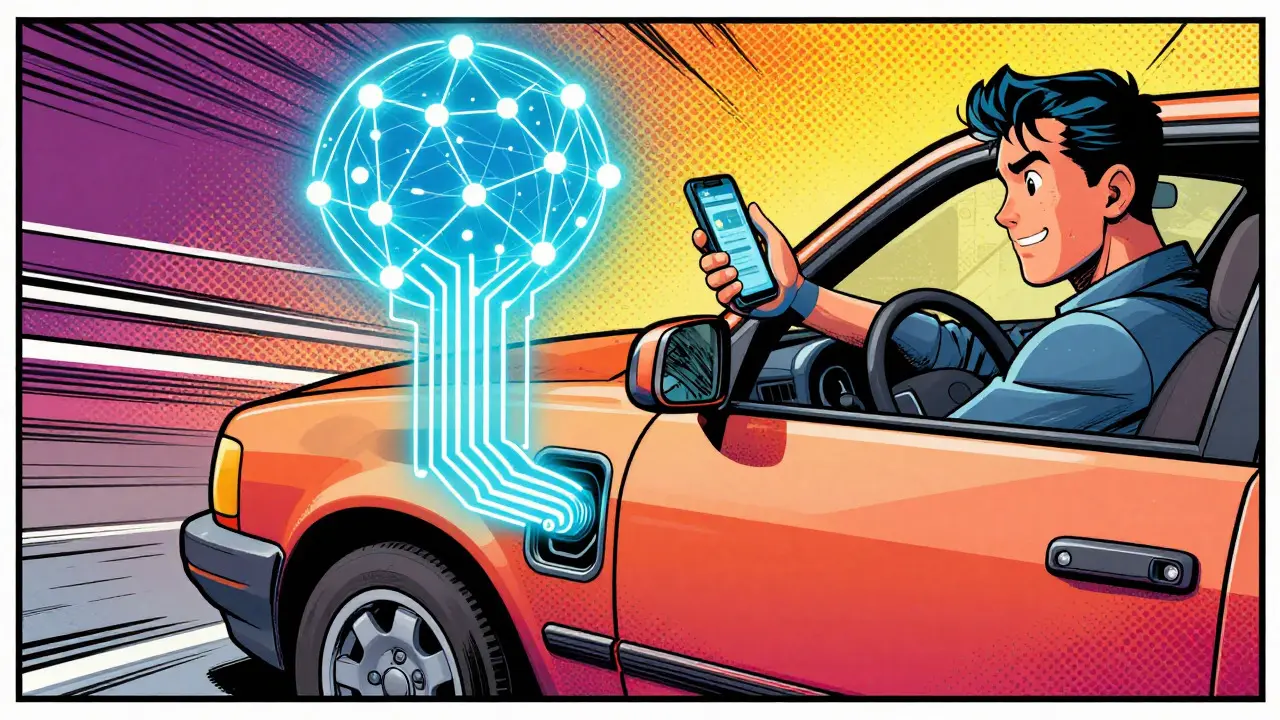
Imagine your car talking. Not just making noises when it needs oil, but actually negotiating its own maintenance history, proving its value to a buyer, and even earning you money while you drive. That is the promise of DIMO, a protocol designed to turn your vehicle into a data-generating asset. For years, automakers like Tesla and Ford have harvested terabytes of data from our cars-braking habits, location, battery health-and kept it locked away in their private servers. You paid for the car, but they owned the insights. DIMO flips this script by putting that power back into your hands using blockchain technology.
If you are wondering what DIMO actually is, it stands for Digital Infrastructure for Moving Objects. It is not just another meme coin or a speculative token with no real-world use case. It is an open-source protocol built on the Ethereum Virtual Machine (EVM) that creates a decentralized identity for vehicles. By connecting your car to the DIMO network, you can collect, store, and monetize your driving data. The native currency of this ecosystem is the $DIMO token, which acts as both a reward mechanism for drivers and a governance tool for the community.
How Does DIMO Work? The Tech Behind the Car
To understand why DIMO matters, you need to look at how it connects the physical world of cars with the digital world of blockchain. Most people think of blockchain as just a ledger for Bitcoin or Ethereum transactions. But DIMO uses it for something more tangible: verifying real-world events.
The system relies on three main components working together:
- Hardware Integration: You cannot just download an app and start earning. You need a way to pull data from your car’s onboard diagnostics (OBD-II port) or via manufacturer APIs. DIMO partners with hardware providers like the DIMO Data Miner, which plugs into your vehicle. This device cryptographically signs the data coming from your car, ensuring it hasn’t been tampered with before it hits the blockchain.
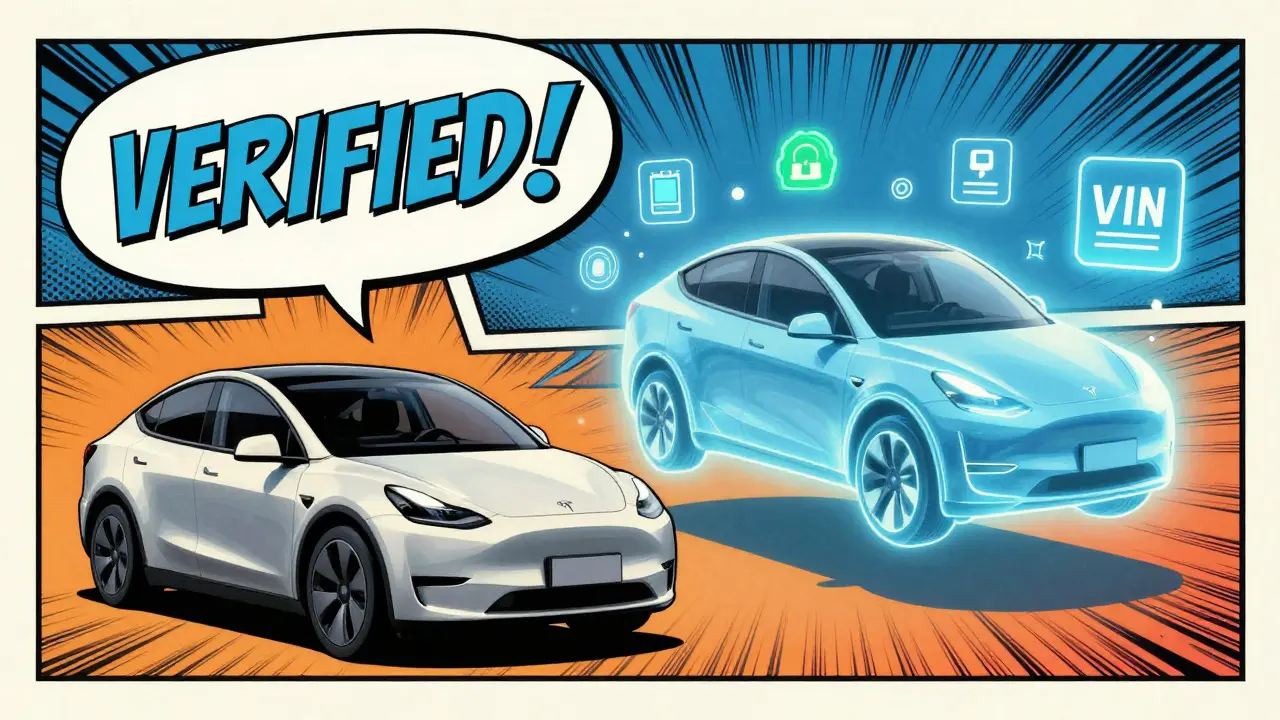
- Vehicle NFTs: When you register your car on the DIMO network, it mints a Non-Fungible Token (NFT) representing that specific vehicle. This isn’t a picture of a car; it is a digital twin. This NFT holds verifiable credentials about your vehicle, such as its VIN, registration status, and maintenance history. If you get an oil change, that event can be recorded on-chain, creating an immutable service record that increases the car’s provenance value.
- Data Marketplaces: Once your data is on the blockchain, you decide who sees it. Do you want to share your driving patterns with an insurance company to prove you are a safe driver? Or maybe share your charging habits with a grid operator to help balance energy demand? You grant permission through smart contracts, and in return, you get paid in $DIMO tokens.
This architecture solves a major trust issue in the used car market. Today, buying a used EV is risky because you rely on the seller’s word regarding battery health. With DIMO, the battery degradation data is verified on-chain. No more lemon surprises.
The Utility of the $DIMO Token
So, what can you actually do with the $DIMO token? It is not just a store of value; it is the fuel that keeps the ecosystem running. The token has several critical functions within the network.
First, it serves as a reward mechanism. Think of it like an airline miles program, but instead of flying, you are driving. Every time your connected vehicle uploads valid telemetry data, you earn $DIMO. This incentivizes users to keep their devices plugged in and their data flowing. The more data you contribute, the more tokens you accumulate.
Second, $DIMO is used for governance. As a decentralized protocol, decisions about the future of the network-who gets access to the API, how fees are structured, and where development funds go-are made by token holders. If you hold $DIMO, you have a vote in the DAO (Decentralized Autonomous Organization) that manages the platform.
Third, there is a deflationary pressure built into the economy. A portion of the tokens used in transactions is burned permanently. This reduces the total supply over time, which can theoretically increase scarcity and value if demand remains steady or grows. The maximum supply of $DIMO is capped at 1 billion tokens, providing a clear ceiling for inflation.
| Attribute | Details |
|---|---|
| Full Name | Digital Infrastructure for Moving Objects |
| Token Symbol | $DIMO |
| Blockchain | Ethereum Virtual Machine (EVM) |
| Max Supply | 1,000,000,000 (1 Billion) |
| Primary Use Case | Vehicle Data Monetization & Governance |
| Hardware Requirement | OBD-II Device or Manufacturer API Access |
Why Car Data is the New Gold
You might be thinking, "Is my driving data really worth anything?" The answer is yes, especially as autonomous vehicles and smart cities become reality. Automakers, insurers, and city planners are desperate for high-quality, real-time traffic and vehicle performance data.
Currently, companies like Waymo or Uber spend billions collecting this data themselves. They hire fleets of cars equipped with sensors. DIMO allows everyday drivers to become part of this data collection network. Instead of one company owning all the data, it is distributed among millions of vehicle owners. This decentralization prevents monopolies on information.
Consider the insurance industry. Traditional insurance premiums are based on broad demographics-your age, gender, and zip code. Usage-Based Insurance (UBI) models exist, but they often require proprietary apps that lock you into one provider. With DIMO, your driving data is portable. You can share your safe-driving record with any insurer that accepts DIMO-verified credentials, potentially lowering your rates without giving up control of your data.
For electric vehicle (EV) owners, the value proposition is even stronger. Battery health is the single biggest factor in an EV’s resale value. Because battery degradation is complex and varies by driver, having an on-chain record of charging cycles, temperature exposure, and state-of-health metrics provides undeniable proof of the car’s condition. This transparency could significantly reduce the spread between buy and sell prices in the used EV market.
Risks and Challenges to Consider
No technology is perfect, and DIMO faces significant hurdles before it becomes mainstream. The biggest barrier is adoption. For the network to be valuable, it needs thousands, if not millions, of connected vehicles. Right now, the user base is growing but still small compared to the hundreds of millions of cars on the road.
There is also the friction of hardware setup. While some newer cars support direct API integration, many older vehicles require a physical OBD-II dongle. Users must plug this in, connect to Wi-Fi, and maintain the connection. If the device falls out or loses power, data collection stops, and rewards pause. This requires a level of technical comfort that not every car owner possesses.
Privacy concerns are another double-edged sword. While DIMO promises user-controlled privacy, sharing detailed location and behavior data always carries risks. Users must carefully manage their permissions. A bug in a smart contract or a misconfigured setting could theoretically expose sensitive data. The open-source nature of the protocol helps here, as the code is auditable by anyone, but trust in the implementation remains key.
Finally, regulatory uncertainty looms over all automotive data projects. Governments are still figuring out how to classify vehicle data ownership. If laws shift to favor automakers over consumers, it could complicate DIMO’s business model. However, the trend in regions like Europe with GDPR is moving toward greater consumer data rights, which aligns well with DIMO’s mission.

Who Is DIMO For?
DIMO is not for everyone. If you drive a 20-year-old sedan with no OBD-II port compatibility and don’t care about tracking your mileage, this probably isn’t for you. It is specifically designed for:
- Tech-Savvy Drivers: People who enjoy tinkering with gadgets and understanding how their data is used.
- EV Owners: Those looking to preserve the value of their electric vehicle through verified maintenance records.
- Freight and Fleet Operators: Businesses that can leverage shared data for route optimization and predictive maintenance.
- Crypto Enthusiasts: Investors interested in the intersection of IoT (Internet of Things) and DeFi (Decentralized Finance).
For developers, DIMO offers an open API to build new applications. Imagine an app that automatically schedules your car wash based on mud detection sensors, or a marketplace that matches you with nearby mechanics who specialize in your exact engine type. The possibilities are limited only by creativity.
Getting Started with DIMO
If you are ready to try it out, the process is straightforward. First, you need a compatible vehicle and either a supported OBD-II device or a car with an open API (like certain Tesla or Ford models). Next, create a wallet that supports EVM networks, such as MetaMask. Connect your wallet to the DIMO dashboard, register your vehicle to mint your vehicle NFT, and install the hardware or link the API.
Once connected, your car starts uploading data blocks. You will see your $DIMO balance grow as you drive. From there, you can choose to stake your tokens for higher rewards, vote on proposals, or simply hold them as you believe in the long-term vision of decentralized mobility.
Is DIMO a good investment in 2026?
Like all cryptocurrencies, DIMO is volatile and speculative. Its value depends on adoption rates, partnerships with automakers, and the broader crypto market. It is not financial advice, but investors should look at the utility of the token and the growth of the user base rather than just price charts.
Do I need an electric vehicle to use DIMO?
No. While EVs offer unique benefits like battery health tracking, DIMO works with internal combustion engines too. Any car with an OBD-II port can connect via compatible hardware.
How does DIMO protect my privacy?
DIMO uses zero-knowledge proofs and encrypted storage. You control who accesses your data via smart contracts. You can share specific data points (like average speed) without revealing others (like exact home address).
Can I sell my vehicle NFT?
Yes. When you sell your car, you can transfer the associated NFT to the new owner. This transfers the entire verified history of the vehicle, adding value to the sale.
What happens if my OBD-II device breaks?
Data collection pauses until the device is replaced or repaired. Your existing data and NFT remain intact on the blockchain, but you will stop earning rewards during the downtime.



There are 13 Comments
Namrata Mapgaonkar
hii friends :) just read this and it seems like a cool idea for cars to earn money while we drive. i have an old hyundai so maybe i can try the obd thing? hope it works well for everyone who tries it :)
Rita Dutta
oh but is it really freedom or just another layer of digital surveillance wrapped in blockchain jargon? the concept of monetizing one's existence through telemetry feels dystopian yet strangely alluring. we are selling our shadows to the algorithmic gods. very interesting paradox indeed.
Paul Smith
This is super exciting stuff! 🚗💨 I’ve been following DIMO since the early days and the potential for EV owners is huge. Imagine getting paid just for charging your car at home and sharing that grid data. It’s a win-win for everyone involved! 🌍✨
Rodmun Tarnowski
Indeed; the implications for the automotive industry are profound! The ability to verify vehicle history on-chain could revolutionize the used car market. Furthermore, the governance aspect ensures that users have a voice in the ecosystem's development. This is truly a step forward!
Matthew Smith
it feels like we are trading privacy for pennies. corporations want our data and now they wrap it in crypto to make us feel special. do we really want every turn recorded forever. morality aside the tech is neat but the ethics are shaky
Prudence Flemming
the zero-knowledge proofs are key here though. if implemented correctly you can prove you drove safely without revealing where you went. it’s about cryptographic assurance rather than trust in institutions. pretty elegant solution to the privacy paradox imo
Carl Michaud
don't be fooled by the hype cycle. this is classic venture capital vaporware designed to extract value from prosumers under the guise of decentralization. the centralization of mining power and validator nodes will inevitably lead to the same monopolistic control as traditional OEMs. wake up sheeple.
Matt Kay
boring. too much setup. just want to drive my car not plug in dongles and worry about wallets. pass.
Dave Kjendal
you people are missing the point. it’s not about the tokens right now it’s about owning your data. eventually the infrastructure will be seamless. stop complaining about hardware when you haven’t even tried it. typical lazy mindset.
Kat Bennett
I think there is a lot of potential here especially for fleet operators who need accurate maintenance records. It would save so much time in verifying service histories and could potentially lower insurance premiums significantly if insurers start accepting these credentials widely. It’s definitely worth keeping an eye on how adoption grows over the next few years.
Candice Cornett
everyone says they own their data but they don’t. once you share it it’s gone. smart contracts can have bugs. why trust code written by anonymous devs over regulated banks. sounds like a scam waiting to happen
Lance Jantz
Oh, darling, you simply don't understand the nuance of decentralized identity! 🎭 It’s not about trusting the code blindly; it’s about auditing the source! The beauty lies in the transparency! You can see exactly how your data flows! It’s a symphony of cryptography and liberty! Don’t let your fear blind you to the magnificent architecture of freedom! ✨🚗
Don Fizy
Hey folks! If anyone is struggling with the OBD-II setup, check out the community guides. They’re really helpful. Just make sure your phone has a stable wifi connection during the initial pairing process. Happy driving and good luck with those rewards! :D
Write a comment
Your email address will not be published. Required fields are marked *