

Imagine holding a digital token that claims to be worth exactly one US dollar. You trust it because you believe the issuer actually has a dollar in a bank account for every token they created. For years, that belief was based on little more than a website disclaimer and hope. Then Tether stumbled, and the cracks showed up everywhere. If you’ve ever wondered how the US government plans to stop another stablecoin collapse from tanking the broader economy, the answer is now written in stone.
The GENIUS Act, officially known as the Guiding and Establishing National Innovation for U.S. Stablecoins Act of 2025, is the first comprehensive federal law designed specifically for stablecoins. Signed into law on July 18, 2025, it doesn’t just suggest best practices; it mandates them. This isn’t about banning crypto or slowing down innovation. It’s about forcing stability issuers to act like banks, even if they aren’t technically banks. The goal? To keep the US dollar dominant in the digital age while protecting everyday users from fraud and insolvency.
What Exactly Is a "Payment Stablecoin"?
Before we get into the rules, let’s clarify what the GENIUS Act actually covers. It targets payment stablecoins. These are digital assets designed to be used as a means of payment or settlement. The key feature here is the redemption obligation. If you hold a payment stablecoin, the issuer is legally obligated to redeem it for a fixed amount of monetary value-usually one US dollar-and must maintain a stable value relative to that fixed amount.
This definition excludes many other types of tokens. It doesn’t cover algorithmic stablecoins that rely on complex code to peg their price (though those might face indirect pressure). It focuses squarely on fiat-backed tokens where the backing asset is supposed to be real money or near-money equivalents. If you’re using a token to buy coffee or settle a business invoice, and it promises to stay at $1.00, this law applies to its issuer.
The Three Pillars of Compliance
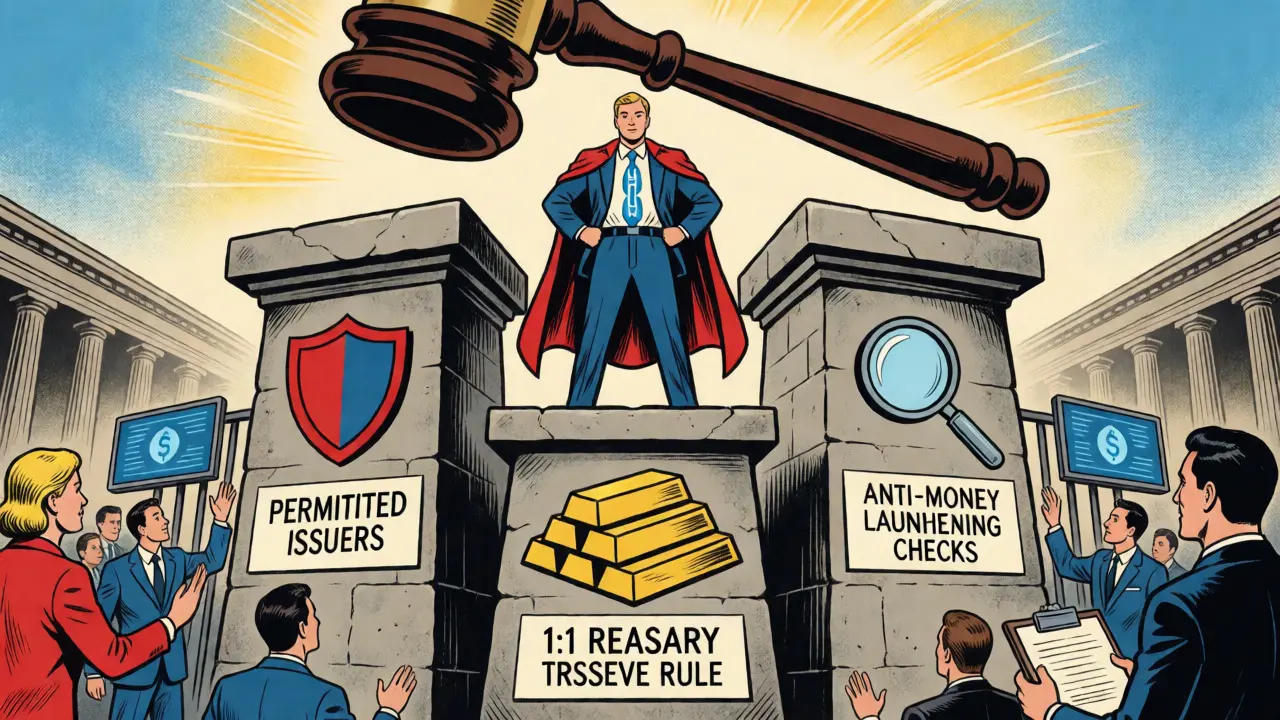
The GENIUS Act rests on three non-negotiable pillars. If an issuer wants to operate in the US market, they have to hit all three marks. There’s no partial credit here.
- Who Can Issue: Only "permitted payment stablecoin issuers" can enter the market. This includes insured depository institutions like banks and credit unions. But it also opens the door for nonbank financial institutions, provided they receive approval from the Federal Reserve and prove they can handle the regulatory load. This is a big shift. Previously, tech companies could launch tokens with minimal oversight. Now, they need serious institutional backing.
- The 1:1 Reserve Rule: This is the heart of the legislation. Issuers must maintain reserves equal to 100% of the stablecoins in circulation. These reserves can’t be speculative bets. They must be held in physical currency, US Treasury bills, repurchase agreements, or other low-risk assets approved by regulators. No more holding volatile crypto assets as backing. If you issue a billion tokens, you need a billion dollars’ worth of safe assets sitting in reserve.
- Anti-Money Laundering (AML) Standards: Stablecoin issuers must comply with the Bank Secrecy Act. This means implementing robust anti-money laundering and counter-financing of terrorism measures. In plain English: know your customer, monitor transactions, and report suspicious activity. Crypto is no longer a shadow economy; it’s subject to the same scrutiny as traditional finance.
Reserves and Audits: How Transparency Works
Trust is hard to build and easy to lose. The GENIUS Act tackles this by mandating transparency. Issuers can’t just say they have the money; they have to prove it. The law requires mandatory reporting of reserve composition. Every quarter, likely more frequently, issuers must disclose exactly what assets back their tokens.
But self-reporting isn’t enough. The Act mandates regular audits by registered public accounting firms. Think of it like the annual audit process for publicly traded companies, but focused strictly on the balance sheet backing the stablecoin. If an auditor finds discrepancies-say, the reserves don’t match the outstanding tokens-the issuer faces immediate regulatory action. This moves us away from the era of "trust me, bro" marketing toward verifiable proof of solvency.
| Feature | Pre-GENIUS Era | Post-GENIUS Act |
|---|---|---|
| Issuer Eligibility | Any company with a web server | Banks, Credit Unions, Fed-approved Nonbanks |
| Reserve Assets | Unregulated (often commercial paper) | Cash, Treasuries, Repos, Low-Risk Approved Assets |
| Audit Frequency | Optional or Infrequent | Mandatory Regular Audits |
| Regulatory Oversight | State-by-state patchwork | Federal Framework + State Coordination |
| Consumer Protection | Limited | Strong AML/KYC & Insurance Links |
The Role of the Stablecoin Certification Review Committee
Who watches the watchers? The GENIUS Act creates a new body called the Stablecoin Certification Review Committee (SCRC). This committee is chaired by the Secretary of the US Department of the Treasury and includes heavy hitters like the Chair of the Federal Reserve and the Chair of the Federal Deposit Insurance Corporation (FDIC).
The SCRC has a critical job: determining whether state-level regulatory frameworks are "substantially similar" to the federal standards. The US has always had a dual banking system, where states can charter their own banks. The same logic applies here. States like New York and Wyoming have tried to create their own stablecoin regimes. The SCRC decides if those state rules are good enough to let issuers operate under state charters without needing full federal approval. If a state’s rules are too loose, the SCRC can effectively override them, ensuring a baseline of protection across the country.
Custody and Rehypothecation: What Issuers Can and Can’t Do
One of the biggest risks in traditional banking is rehypothecation-using client assets as collateral for other loans. The GENIUS Act puts strict limits on this. Generally, stablecoin issuers cannot rehypothecate collateral held in reserves. Your dollar isn’t being lent out to hedge funds behind your back.
There is a narrow exception. Issuers can pledge Treasury bill reserves as collateral for short-term repurchase agreements (repos) to manage liquidity. This allows them to meet sudden redemption demands without selling off assets at a loss. However, these repos must be cleared by approved central clearing counterparties or require prior regulatory approval. This balances operational flexibility with risk containment.
Furthermore, custody services are tightly regulated. If an issuer holds private keys or reserves for customers, they must do so under federal or state banking regulator oversight. There’s a carve-out for technology providers offering hardware wallets or software for self-custody. If you hold your own keys, the issuer isn’t liable for your lost password. But if the issuer holds the keys, they are acting as a custodian and face strict liability rules.

Why This Matters for the Global Dollar
You might ask, why does the US care so much about regulating a niche crypto product? It’s about power. The US dollar is the world’s reserve currency. Stablecoins are increasingly used for cross-border payments, remittances, and trade settlement. If the US lets unregulated, opaque stablecoins fail, people might turn to alternatives like the Euro or China’s digital yuan.
By creating a clear, rigorous framework, the GENIUS Act aims to make US-backed stablecoins the safest and most reliable option globally. It signals to international markets that American digital dollars are backed by solid law, not just marketing. This helps maintain the dollar’s dominance in the digital economy. Other jurisdictions are taking note. Hong Kong passed its own Stablecoin Ordinance in May 2025. The race is on to see which jurisdiction becomes the hub for compliant, scalable digital cash.
Implementation Timeline and Market Impact
The law was signed in July 2025, but the real impact starts later. The effective date is set for January 18, 2027, or 120 days after implementing regulations are issued, whichever comes first. This gives issuers an 18-month window to adjust their operations. They need to upgrade their compliance systems, secure proper banking partnerships, and prepare for audits.
For consumers, this transition period might mean some consolidation. Smaller issuers who can’t afford the compliance costs may exit the market. Larger players like Circle (USDC) and potentially Tether (if they fully comply) will likely strengthen their positions. Expect fewer, but safer, options in the wallet. The chaotic wild west of 2021 is over. We are entering the era of regulated digital cash.
Frequently Asked Questions
Does the GENIUS Act apply to Bitcoin?
No. The GENIUS Act specifically targets "payment stablecoins," which are digital assets pegged to a fixed monetary value like the US dollar. Bitcoin is a volatile asset with no fixed redemption value, so it falls outside this specific regulatory framework.
Can I still use stablecoins from foreign issuers?
Foreign issuers must comply with US regulations if they want to serve US customers. They generally need to partner with a permitted US issuer or obtain approval through the federal framework. Simply operating offshore won't exempt them from consumer protection laws when dealing with American users.
What happens if a stablecoin issuer fails?
The Act mandates segregation of assets. This means your stablecoins are backed by specific reserves that should not be mixed with the issuer's general business funds. If the issuer goes bankrupt, creditors of the issuer shouldn't be able to seize those reserves easily, providing a layer of protection for token holders.
Are state stablecoin laws dead now?
Not entirely. The GENIUS Act creates a federal baseline, but states can still regulate stablecoins if their rules are deemed "substantially similar" to federal standards by the Stablecoin Certification Review Committee. States like New York may continue to play a role, but they cannot enforce rules that are significantly weaker than the federal mandate.
Will this kill DeFi (Decentralized Finance)?
It won't kill DeFi, but it will change how stablecoins interact with it. Centralized, regulated stablecoins will become the primary bridge between traditional finance and DeFi. Decentralized stablecoins that don't fit the "payment stablecoin" definition may face different regulatory hurdles, but the core DeFi infrastructure remains intact.