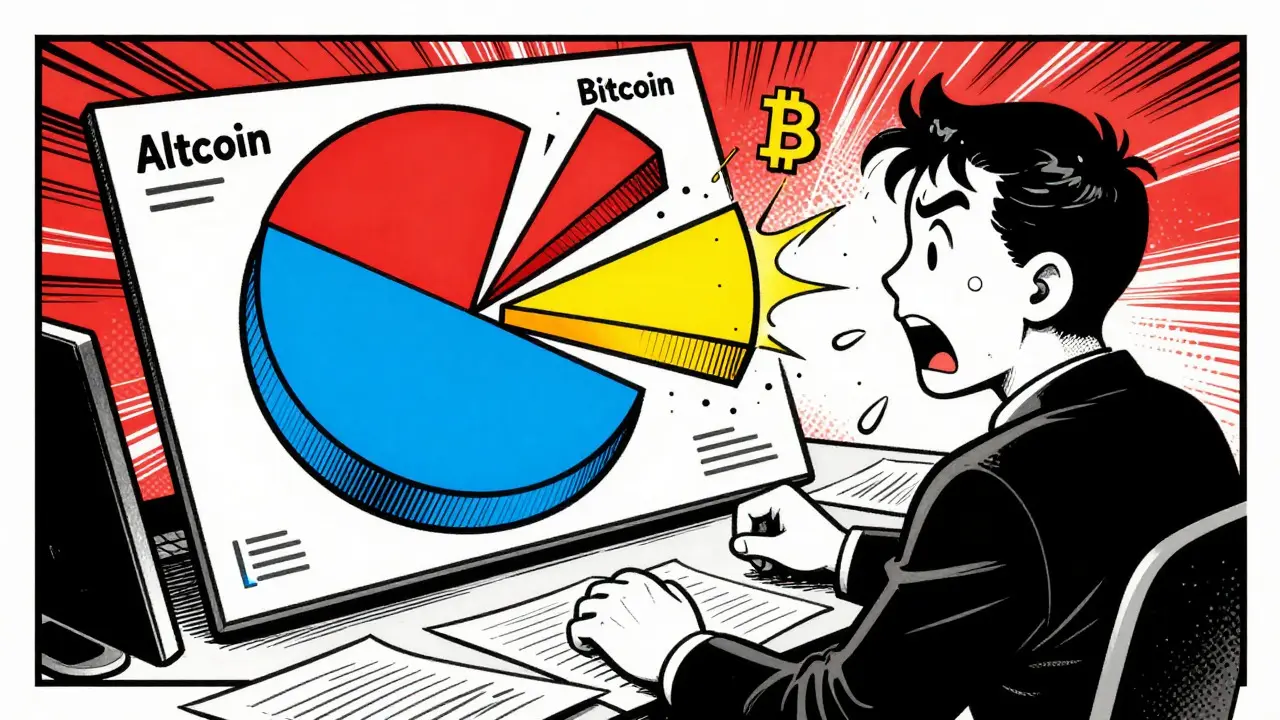
You bought Bitcoin when it was $30,000. You grabbed some Ethereum on the dip. Maybe you threw a few hundred dollars into a trendy altcoin because your friend mentioned it. Six months later, you check your dashboard and panic sets in. That one altcoin has tripled, now making up 40% of your entire net worth, while your Bitcoin has barely moved. Suddenly, your "diversified" portfolio feels like a single-asset gamble.
This is exactly why crypto portfolio rebalancing is the systematic process of adjusting cryptocurrency holdings to maintain predetermined allocation percentages matters so much. It’s not just about chasing profits; it’s about keeping your risk profile intact. Without it, market volatility quietly shifts your strategy from conservative to reckless without you even noticing.
Why Your Allocations Drift (And Why It Matters)
In traditional finance, stocks might move 10-20% in a year. In crypto, assets can swing 50% in a week. According to research by Zignaly published in October 2024, cryptocurrency prices fluctuate 5 to 10 times more than traditional assets. This extreme volatility means that if you start with an equal-weight portfolio-say, 25% Bitcoin, 25% Ethereum, 25% Solana, and 25% Stablecoins-a strong run in Solana could push its weight to 35% or higher almost overnight.
When this happens, two things occur:
- Risk Concentration: You are now overexposed to the most volatile asset. If Solana crashes, your whole portfolio takes a bigger hit than intended.
- Missed Opportunities: The assets that didn’t rise (like your stablecoins or lagging coins) represent cash sitting on the sidelines that could be buying low.
The goal of rebalancing is to force yourself to sell high and buy low systematically. Academic analysis from Quantpedia in March 2024 highlights a "rebalancing premium," showing that periodically rebalanced crypto portfolios outperform simple buy-and-hold strategies by 3.2% to 5.7% annually on average. This isn’t magic; it’s math. By trimming winners and adding to losers, you capitalize on mean reversion-the tendency of crypto prices to bounce back toward their average after sharp moves.
Two Main Ways to Rebalance
There is no single "best" way to rebalance, but there are two dominant methodologies used by both retail traders and institutions. Choosing the right one depends on how much time you want to spend managing your money and your tolerance for transaction fees.
| Feature | Time-Based (Periodic) | Threshold-Based |
|---|---|---|
| Trigger | Fixed intervals (Daily, Weekly, Monthly) | Asset drifts beyond set % (e.g., ±20%) |
| Best For | Highly volatile markets with mean reversion | Trending markets; minimizing unnecessary trades |
| Frequency | Predictable and consistent | Variable; can be rare or frequent |
| Cost Efficiency | Lower; fewer checks needed | Higher potential savings on fees if thresholds are wide |
| Data Source | Finestel 2025 Study | Zignaly 2024 Research |
Time-Based Rebalancing
This is the simplest approach. You pick a schedule-daily, weekly, or monthly-and stick to it. A benchmark study by Finestel in January 2025 found that 68.3% of active crypto traders use daily rebalancing, while 22.1% prefer weekly cycles. Only 9.6% use monthly intervals.
Daily rebalancing works well in choppy, sideways markets where prices oscillate around a mean. However, it comes with a catch: transaction costs. If you trade every day, you pay fees every day. During strong bull runs, time-based rebalancing can actually hurt returns because you keep selling winners too early, missing out on sustained momentum. Quantpedia’s backtesting showed that daily-rebalanced portfolios underperformed buy-and-hold by 4.2% during strong bull markets due to this premature profit-taking.
Threshold-Based Rebalancing
Instead of watching the calendar, you watch the percentages. You set a "tolerance band." For example, if your target for Bitcoin is 25%, you might set a threshold of ±20%. This means you only rebalance when Bitcoin’s allocation drops below 20% or rises above 30%.
This method is generally more efficient. Data from Lazy Portfolio ETF in September 2025 showed that threshold-based rebalancing with a 10% tolerance achieved similar returns to yearly rebalancing but required far fewer transactions (7 vs. 17 rebalances over 17 years). Fewer trades mean lower fees and less tax complexity. Advanced investors even use volatility-adjusted bands, giving wider tolerance to wild altcoins (±30%) and tighter control to stable assets like Bitcoin (±15%).
The Hidden Costs: Fees, Taxes, and Slippage
Rebalancing sounds great in theory, but execution is where many investors lose money. You need to account for three major friction points.
- Transaction Fees: Every time you swap tokens, you pay a fee. On major exchanges, this averages 0.2% to 0.5% per trade. If you rebalance a $10,000 portfolio five times a month, you’re losing hundreds of dollars annually just in fees. User feedback from Reddit’s r/CryptoCurrency shows traders losing significant value to fees during consolidation phases.
- Tax Implications: In many jurisdictions, including the US and New Zealand, every sale is a taxable event. If you rebalance frequently, you trigger capital gains taxes constantly. This is why 63% of negative reviews for rebalancing tools cite tax reporting complexity as a major pain point (TokenMetrics User Survey, April 2025).
- Slippage: When you execute a large trade, especially in volatile conditions, the price may change between the time you click "sell" and when the order fills. XBTO’s Institutional Report from February 2025 notes that manual rebalancing often incurs 0.5% to 1.2% additional costs from slippage during volatile market conditions.
To mitigate these costs, many investors use automated tools. Platforms like 3Commas and Finestel Terminal connect to your exchange via API and execute trades automatically when thresholds are met. This reduces emotional decision-making and minimizes slippage by using limit orders rather than market orders.
Advanced Strategies: Risk Parity and Thematic Tilts
Once you master basic equal-weight rebalancing, you can explore more sophisticated models designed to optimize risk-adjusted returns.
Risk Parity Allocation
Traditional equal-weighting assumes all assets carry the same risk. They don’t. Bitcoin is far less volatile than a small-cap meme coin. Risk-parity models weight assets by inverse volatility. This means you hold less of the volatile assets and more of the stable ones, so each contributes equally to the portfolio’s overall risk. XBTO data shows that risk-parity portfolios reduced drawdowns by 18.3% during the 2022 crypto winter compared to equal-weight portfolios.
Thematic Tilt Portfolios
If you have high conviction in a specific sector, you can "tilt" your portfolio. For example, a DeFi-focused portfolio might allocate 40% to BTC/ETH, 30% to DeFi tokens, 15% to general alts, and 15% to stablecoins. This generated 47.2% annualized returns during the 2021 DeFi boom but suffered 63.8% drawdowns during the 2022 collapse. The key here is to rebalance strictly within the theme to avoid overexposure to a single failing protocol.
Tools and Automation: Making It Work in 2026
Manual rebalancing is error-prone and time-consuming. Managing a complex portfolio with 15+ assets manually can take 8-10 hours a month, according to Zignaly’s Beginner’s Guide. Automation is becoming the standard, especially as institutional adoption accelerates. Institutional crypto portfolios now represent $184.3 billion in assets under management, with 82% employing systematic rebalancing (CryptoCompare Institutional Report, Q2 2025).
Here are the top tools currently shaping the landscape:
- 3Commas: Holds 34.7% market share in rebalancing tools. Users praise its "smart threshold calculator" but note the interface can be complex for beginners. Average rating: 4.3/5 stars on Trustpilot.
- Finestel Terminal: Known for aggregating data across multiple exchanges and automating tax calculations. Its AI-driven adaptive rebalancing (launched March 2025) uses machine learning to adjust thresholds based on volatility, reducing unnecessary trades by 37%.
- Binance Bot: Excellent for users who hold everything on Binance. Fast execution but limited to Binance assets. Rating: 3.8/5 stars on Capterra.
- Pionex: Offers built-in grid trading bots that effectively rebalance within price ranges. Documentation scores lower (3.2/5) but functionality is robust for intermediate users.
When choosing a tool, look for real-time portfolio tracking, multi-exchange support, and automated tax reporting. Avoid platforms that require you to move funds unnecessarily, as this increases security risks and withdrawal fees.

Common Mistakes to Avoid
Even with the best tools, human error remains the biggest threat to your portfolio. Here are the most common pitfalls:
- Over-Rebalancing: As Dr. Michael Chen of CoinDesk Research warns, over-rebalancing in strongly trending markets can reduce returns by 15-20% annually. Don’t let a bot sell your Bitcoin at $60,000 to buy a dip that turns into a crash. Use adaptive thresholds that widen during high volatility.
- Ignoring Correlation: During market crashes, crypto assets often correlate at 80-90%. Rebalancing won’t save you if everything drops together. Ensure your portfolio includes non-correlated assets like stablecoins or gold-backed tokens.
- Tax Negligence: Failing to track every trade leads to massive tax bills later. Use software that integrates with your local tax laws. In New Zealand, for instance, crypto held as an investment is subject to different rules than crypto held for trading purposes.
- Chasing Performance: Don’t rebalance into an asset just because it’s hot. Stick to your original thesis. If you allocated 5% to an altcoin, keep it at 5% unless your fundamental view on that project changes.
Next Steps for Your Portfolio
Start simple. Define your target allocation. Are you 60% Bitcoin, 30% Ethereum, 10% Stablecoins? Write it down. Then choose a method: time-based (monthly) or threshold-based (±20% drift). Set up alerts or automate the process using a trusted platform. Monitor your performance quarterly, not daily. Remember, rebalancing is a marathon, not a sprint. It’s about preserving capital during downturns and capturing steady growth during uptrends, without letting emotions drive your decisions.
How often should I rebalance my crypto portfolio?
There is no one-size-fits-all answer, but most active traders rebalance weekly or monthly. Threshold-based rebalancing (triggered when an asset drifts ±20% from its target) is often more efficient as it reduces unnecessary trades and fees. For long-term holders, quarterly rebalancing may suffice.
Does rebalancing always increase returns?
Not necessarily. In strong bull markets, rebalancing can reduce returns because you sell winning assets too early. However, it significantly reduces risk and drawdowns during bear markets. The "rebalancing premium" typically adds 3.2-5.7% annually in volatile, mean-reverting markets.
What are the tax implications of rebalancing?
In many countries, every sale of crypto is a taxable event. Frequent rebalancing can lead to significant capital gains taxes. Use automated tools that track cost basis and integrate with local tax regulations to minimize errors and compliance issues.
Is automated rebalancing safe?
Automated rebalancing reduces human error and emotional trading, but it carries technical risks. Ensure you use reputable platforms with strong security records. Be aware of API key permissions and monitor for system outages, which can cause missed trades or slippage during high volatility.
What is the difference between time-based and threshold-based rebalancing?
Time-based rebalancing occurs at fixed intervals (e.g., every month), regardless of market movement. Threshold-based rebalancing triggers only when an asset’s allocation drifts beyond a set percentage (e.g., ±20%) from its target. Threshold-based is generally more cost-efficient.