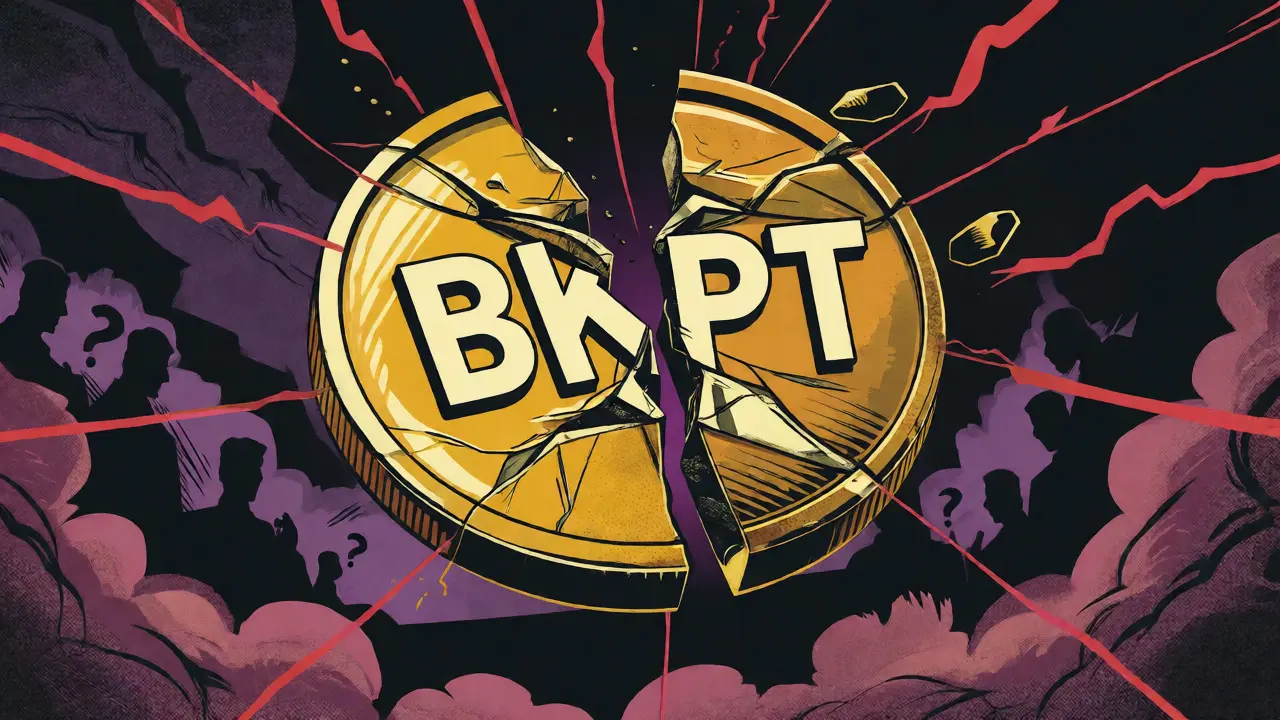
You see a shiny new token promising to revolutionize trading with a "hybrid" model and Shariah compliance. You check the price: it’s down nearly 99% from its peak. You look for volume: there’s almost none. This is the current state of Biokript (BKPT), a cryptocurrency that claims to be the world's first hybrid, Shariah-compliant platform but struggles to prove it has any real market traction.
If you are wondering whether this project is the next big thing or just another ghost town on the blockchain, you need to look past the marketing buzzwords. The data tells a very different story than the website does. Let’s break down what Biokript actually is, why the numbers don’t add up, and whether your money is safe here.
The Core Promise: Hybrid Trading and Profit Sharing
Biokript pitches itself as a solution to the fragmentation in crypto trading. It claims to merge the speed and ease of a Centralized Exchange (CEX) with the security and self-custody benefits of a Decentralized Exchange (DEX). The central entity here is the Biokript Platform, which describes itself as a non-custodial hybrid exchange leveraging Solana technology.
The biggest hook? A "50/50 profit share." The idea is that 50% of trading fees generated by the platform go directly to BKPT token holders. On paper, this sounds incredible. If the platform makes $1 million in fees, you get $500,000 distributed among holders. But here is the catch: how do you distribute profits when the market cap is reported as zero?
The platform operates on the Solana blockchain, known for high speed and low costs. They claim proprietary tech, including AI-driven trade execution and anti-rug mechanisms. They even mention a partnership with Microsoft for security, though no technical documentation verifies this link. Without verifiable code or active development updates, these features remain promises rather than products.
Market Data: The Red Flags Are Blaring
Let’s look at the hard numbers, because they are brutal. As of late 2025, BKPT trades around $0.000104 USD. That is a massive drop from its all-time high of roughly $0.0106. We are talking about a decline of over 99%. For most investors, seeing a token lose that much value is a sign of failed adoption or a pump-and-dump cycle.
More concerning is the liquidity. Binance, one of the largest exchanges globally, lists BKPT in their database but explicitly states: "This coin is not listed on Binance for trading and services." Why? Likely due to regulatory concerns or lack of genuine volume. CoinGecko reports a 24-hour trading volume of just $27.86. Yes, twenty-seven dollars. In a market where top coins trade billions daily, this number suggests that almost nobody is buying or selling BKPT.
| Metric | Biokript (BKPT) | Industry Standard (e.g., Uniswap/Coinbase) |
|---|---|---|
| Market Cap | $0 (reported by Binance) | Billions to Trillions |
| 24h Volume | <$30 | Millions to Billions |
| Exchange Listings | Minor DEXs only | Major CEXs & DEXs |
| Transparency | No public GitHub/Whitepaper details | Open-source code & audits |
The discrepancy between the claimed "active platform" and the $0 market cap is the biggest warning sign. If a platform generates fees, it needs users. If it has users, it needs volume. If it has volume, it needs a market cap. Biokript seems to have broken this chain early on.
Who Is Behind It? The Team and Technology
Trust in crypto often comes down to transparency. Who built this? The official website lists roles like CEO, Web3 Developer, and Marketing Manager, but specific names are scarce. In an industry where doxxed teams inspire confidence, anonymity raises eyebrows.
They claim a "pending U.S. utility patent" for their hybrid exchange system. Note the word "pending." A pending patent offers no legal protection and doesn't prove the technology works. Many crypto projects use vague IP claims to sound innovative without delivering functional software. Furthermore, the claimed integration with Microsoft lacks corroboration. Microsoft’s partner directory does not highlight Biokript as a key blockchain partner, making this claim feel more like marketing fluff than a technical reality.
The token contract exists on Solana, meaning the asset itself is real. You can buy it, hold it, and send it. But holding a token is different from using a functioning exchange. If the platform behind the token isn't processing significant trades, the "profit share" mechanism has nothing to distribute.
Community Sentiment: Skepticism Rules
What are actual users saying? Very little, because very few people are active. On Reddit threads discussing Biokript, sentiment leans heavily toward skepticism. Users question the math: How can you share 50% of profits if there are no profits? Trustpilot shows no reviews, which is typical for projects that haven't reached mass adoption. CoinGecko user ratings average a dismal 1.3 out of 5 stars.
Complaints focus on the "Whale NFT" program. The site suggested buying NFTs would grant trading credits equal to the investment. Users reported paying thousands of dollars for these NFTs but failing to redeem the promised credits. When support channels like Telegram (with only ~1,200 members) respond slowly or vaguely, trust erodes quickly. An 87% negative sentiment score across community platforms indicates that early adopters feel misled.

Is Biokript Shariah-Compliant?
Biokript markets itself heavily to Muslim investors, claiming to be the first Shariah-compliant hybrid platform. While Islamic finance principles generally prohibit interest (riba) and excessive uncertainty (gharar), verifying compliance requires oversight from recognized Islamic finance scholars. Biokript does not list a certified Shariah board or provide audit certificates from reputable Islamic financial bodies.
Compare this to competitors like Islamic Coin (ISLM), which has a clearer governance structure regarding compliance. Without third-party verification, the "Shariah-compliant" label is essentially self-declared. For investors who prioritize religious adherence, this lack of external validation is a significant hurdle.
Should You Invest in BKPT?
Here is the blunt truth: Biokript currently looks like a zombie project. The price action, volume, and community engagement all point to a project that has lost momentum. The promise of high returns via profit-sharing is attractive, but it relies entirely on a hypothetical future where the platform gains massive adoption. Given the current $0 market cap and negligible volume, that future seems distant.
If you are considering buying BKPT, treat it as a high-risk lottery ticket, not an investment. The barriers to entry are low, but the risk of total loss is extremely high. There is no guarantee you will be able to sell your tokens later, given the lack of liquidity. Always verify contracts on block explorers and never invest money you cannot afford to lose.
Is Biokript listed on major exchanges like Binance?
No. While Biokript appears in Binance's data listings, Binance explicitly states that BKPT is not listed for trading. You can typically find it on smaller decentralized exchanges on the Solana network, such as Raydium or Jupiter, but liquidity is very low.
How does the 50/50 profit share work?
The platform claims to distribute 50% of trading fees to BKPT holders. However, since the platform currently has minimal trading volume, there are effectively no fees to distribute. Until the platform generates significant revenue, this feature remains theoretical.
Is Biokript really Shariah-compliant?
Biokript claims to be Shariah-compliant, but there is no public evidence of certification from independent Islamic finance authorities. Investors seeking strict compliance should look for projects with verified Shariah boards and published audit reports.
Why did the BKPT price drop so much?
The price dropped over 99% likely due to a combination of factors: initial hype fading after presales, lack of sustained marketing, low liquidity causing slippage, and possibly selling pressure from early investors. The absence of a strong community also contributed to the decline.
Can I trust the Microsoft partnership claim?
Treat this claim with caution. There is no press release or technical documentation from Microsoft confirming a partnership with Biokript. Often, startups may use cloud services from Microsoft Azure and loosely call it a "partnership," but this does not imply deep technological integration or endorsement.