
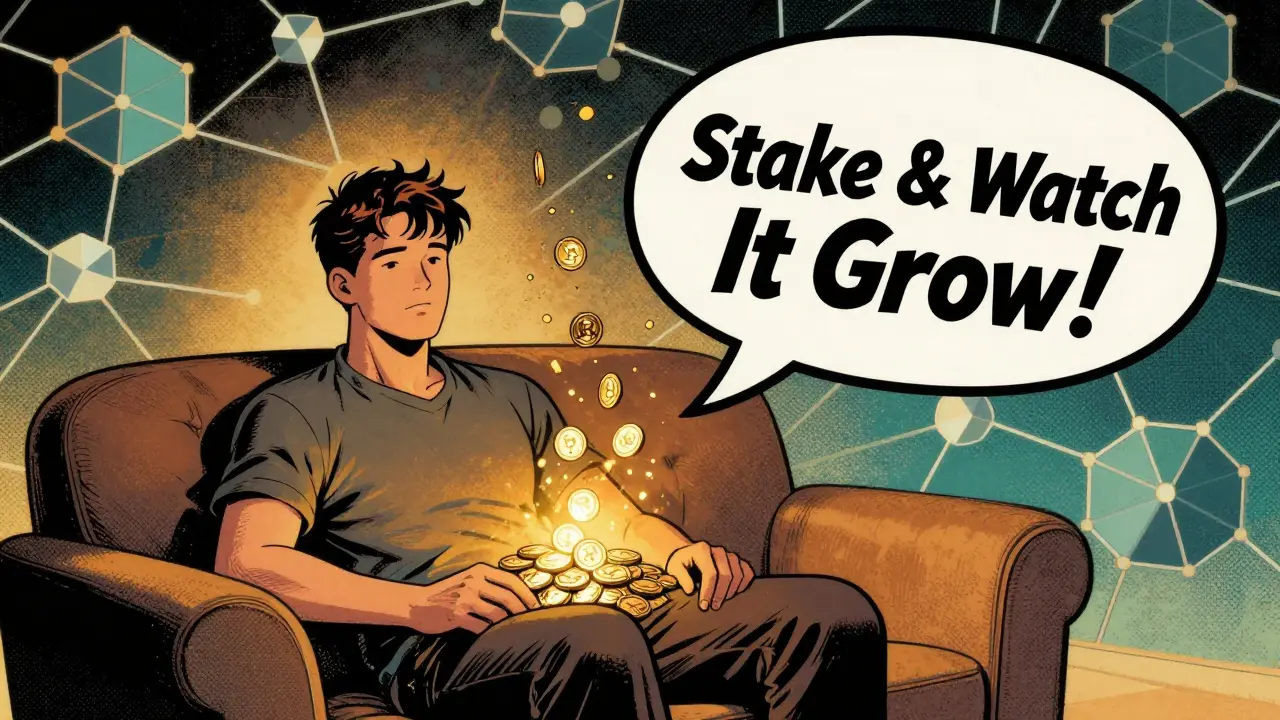
Imagine earning interest on your cryptocurrency just by holding it. No trading. No timing the market. Just letting your coins sit still and grow. That’s cryptocurrency staking - and it’s one of the most straightforward ways to earn passive income in crypto today.
How Staking Works: Locking Coins to Secure the Network
Cryptocurrency staking is how some blockchains verify transactions without using massive amounts of electricity. Instead of relying on miners solving complex math problems (like Bitcoin does), staking uses a system called proof-of-stake (PoS). In PoS, the people who help run the network are chosen based on how many coins they’re willing to lock up - or "stake" - as collateral. When you stake your coins, you’re essentially saying: "I believe in this network, and I’m putting my money where my mouth is." In return, the network gives you rewards. These rewards come in the form of new coins minted by the blockchain itself. Think of it like a savings account, but instead of a bank paying you interest, the blockchain does. The more coins you stake, the higher your chances of being selected to validate the next block. But it’s not just about who has the most. Many networks add randomness to the selection process so that even small stakers have a fair shot. This keeps the network decentralized and prevents big players from taking over.Why Staking Matters: Energy Efficiency and Network Security
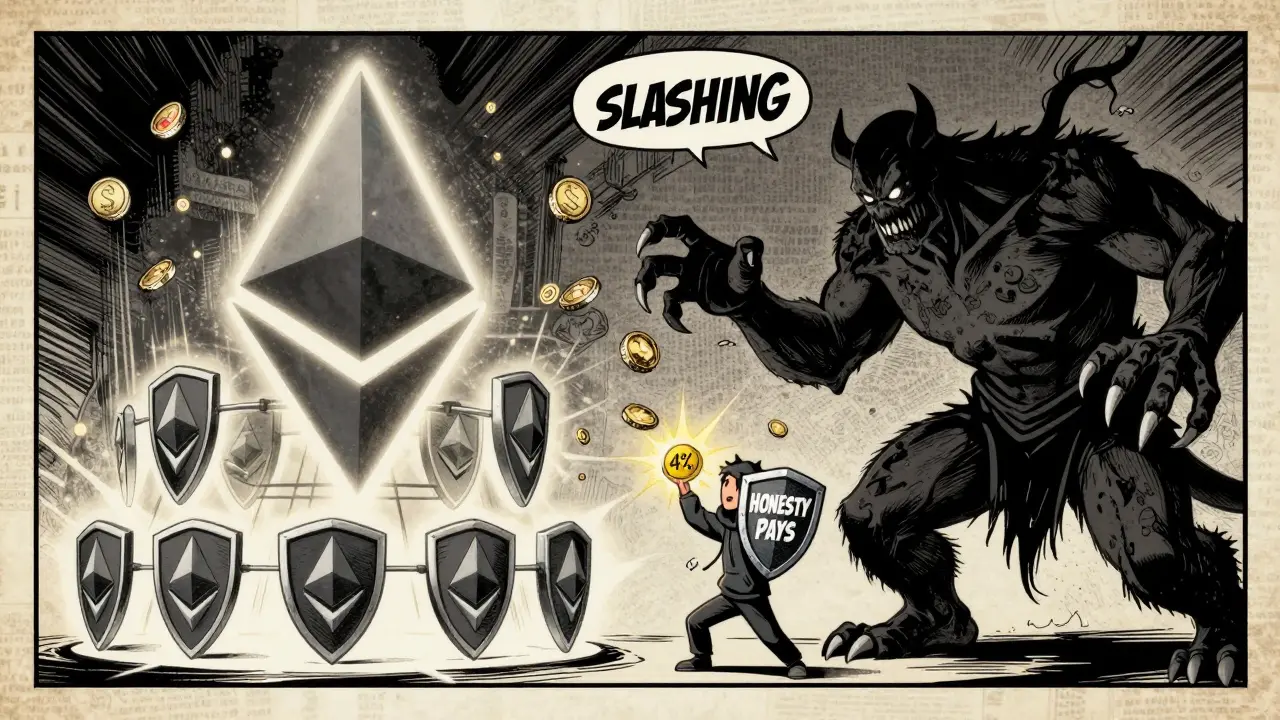
Before staking became popular, most blockchains relied on proof-of-work (PoW). That’s the system Bitcoin uses - and it’s incredibly energy-intensive. One estimate suggests Bitcoin mining uses more electricity than entire countries. Staking changed that. Networks like Ethereum switched from PoW to PoS in 2022, cutting their energy use by over 99%. That’s not just good for the planet - it’s good for long-term sustainability. Staking also makes the network more secure. If someone tries to cheat - like approving fake transactions - they risk losing their staked coins. This penalty is called "slashing." It’s a powerful deterrent. Why would you risk losing thousands of dollars worth of crypto just to mess with the system? The system is designed so that being honest pays off.How You Earn Rewards: The Math Behind the Numbers
Rewards aren’t fixed. They vary by network. For example:- Ethereum staking pays around 3% to 5% annually.
- Solana offers between 6% and 8%.
- Cardano typically gives 4% to 5%.
How to Stake: Exchanges, Pools, or Running Your Own Node
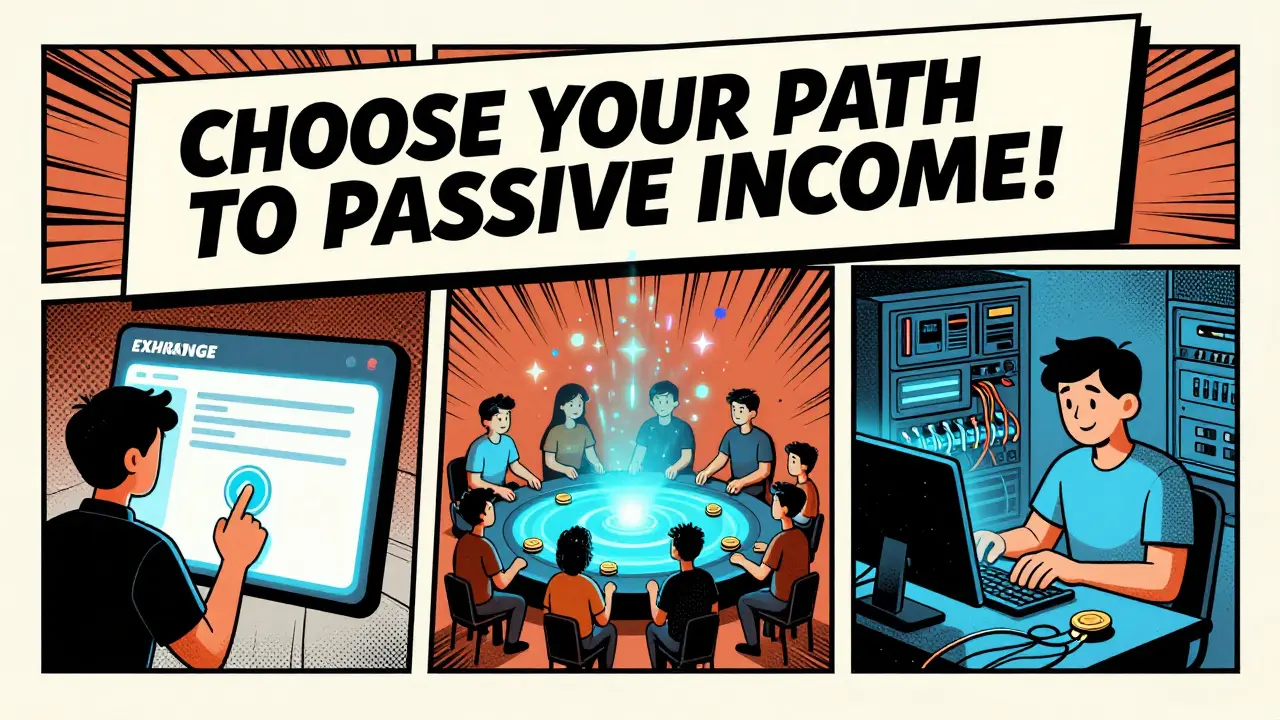
You don’t need to be a tech expert to stake. In fact, most people do it through exchanges. Staking via exchanges (like Coinbase, Binance, or Kraken) is the easiest way. You just click a button, lock your coins, and start earning. The exchange handles everything - from validator setup to slashing protection. But there’s a trade-off: you don’t have full control over your coins. You’re trusting the exchange. Staking pools let you combine your coins with others to increase your chances of being selected. This is great if you don’t have enough coins to meet the minimum requirement (like 32 ETH for Ethereum’s main validator). Pools charge a small fee (usually 5%-15% of rewards), but they make staking accessible to everyone. Running your own validator is for advanced users. You need to buy hardware, set up software, keep your machine online 24/7, and understand how to avoid slashing. It’s not for beginners. But if you do it right, you avoid third-party fees and gain full control.Risks You Can’t Ignore
Staking isn’t risk-free. Here are the big ones:- Slashing: If your validator goes offline or signs a fraudulent block, you can lose part of your stake. This is rare on exchanges but real if you run your own node.
- Market volatility: Your coins could drop in value while they’re locked. You might earn 5% in rewards, but lose 10% in price. Net loss? That happens.
- Lockup periods: Some networks won’t let you unstake for days or even weeks. If you need cash fast, you’re stuck.
- Exchange risk: If the platform you’re staking with gets hacked or shuts down, you could lose access to your funds.
Which Coins Can You Stake?
Not every cryptocurrency supports staking. Here are the most popular ones as of 2026:- Ethereum (ETH): The biggest PoS chain. Requires 32 ETH to run your own validator. Many use staking pools instead.
- Solana (SOL): Fast, low-cost, high rewards. Easy to stake through exchanges.
- Cardano (ADA): One of the earliest PoS networks. Known for strong community governance.
- Polygon (MATIC): Popular for decentralized apps. Offers solid yields with low entry barriers.
- Polkadot (DOT): Lets you stake and nominate validators. Good for long-term holders.
Staking vs. Other Crypto Earning Methods
People often confuse staking with lending, mining, or yield farming.- Staking: You help secure the blockchain. Rewards come from new coin issuance. No third-party borrower involved.
- Lending: You loan your crypto to someone else (like a DeFi platform). You’re exposed to counterparty risk - if they default, you lose money.
- Mining (PoW): Uses powerful computers and tons of electricity. Not sustainable. Not practical for most people.
- Yield farming: You provide liquidity to trading pools. High returns, but high risk of smart contract bugs or impermanent loss.
What’s Next for Staking?
Liquid staking is the next big thing. It lets you stake your coins and still use them elsewhere - like in DeFi apps or as collateral. For example, you stake your ETH and get a token called stETH in return. You can trade stETH, lend it, or use it in other protocols - while still earning staking rewards. This removes the biggest downside of staking: losing access to your funds. Regulation is also catching up. Governments are starting to define how staking rewards are taxed. In some places, they’re treated as income. In others, they’re taxed when you sell. Stay informed - tax rules can change fast.Final Thoughts: Is Staking Worth It?
If you believe in a blockchain’s future, staking is one of the smartest ways to earn while supporting it. It’s simple, energy-efficient, and doesn’t require trading skills. You’re not gambling - you’re investing in infrastructure. Start small. Use a trusted exchange. Read the terms. Don’t stake everything. And remember: rewards are nice, but protecting your principal matters more.Can you lose money staking cryptocurrency?
Yes. You can lose money if the price of the coin drops while your coins are locked. You can also lose part of your stake through slashing if you run your own validator and make mistakes. Exchanges reduce this risk, but they don’t eliminate it. Always understand the risks before staking.
How often do staking rewards get paid?
It depends on the network. Ethereum pays rewards roughly every 6.4 minutes (every new block), but they’re usually distributed to users weekly or monthly. Solana and Cardano typically pay out daily or every few days. Exchanges often consolidate payments to once a week for simplicity.
Do you need to be a tech expert to stake crypto?
No. Most people stake through exchanges like Coinbase or Binance - it’s as easy as clicking a button. You only need technical skills if you want to run your own validator node, which requires setting up hardware, software, and constant monitoring. For 95% of users, exchanges are the best option.
What’s the minimum amount to start staking?
It varies. Ethereum requires 32 ETH to run your own validator - that’s over $100,000. But through staking pools or exchanges, you can start with as little as 0.001 ETH or $10 worth of crypto. Solana, Cardano, and Polygon allow staking with any amount, even fractions of a coin.
Is staking safer than holding crypto?
It’s about the same risk level. Staking doesn’t make your coins more secure - it just gives you rewards. If the exchange gets hacked or the network suffers a bug, your staked coins are still at risk. The main difference is opportunity cost: while staked, you can’t sell if the price crashes. So it’s not safer - it’s just a way to earn while holding.
Are staking rewards taxable?
In most countries, yes. Staking rewards are usually treated as income when you receive them. That means you may owe taxes based on the coin’s value at that moment. Some countries tax them only when you sell. Always check your local tax rules - crypto regulations are changing fast.


There are 14 Comments
Michelle Xu
Staking is honestly one of the few crypto things that feels like actual investing instead of gambling. You’re not trying to time some wild pump, you’re just helping the network run smoothly and getting paid for it. It’s like a dividend, but for blockchain.
And yeah, the energy savings alone make this worth it. Ethereum’s switch to PoS was one of the most underrated wins in tech history. We’re talking the difference between a gas-guzzler and a Prius.
Just make sure you’re not staking on some sketchy exchange. I’ve seen people lose everything because they trusted a platform that didn’t even have two-factor auth. Use Coinbase, Kraken, or stake directly if you can.
Also, never stake money you might need in the next 6 months. Lockup periods can sneak up on you. I learned that the hard way when my Cardano got stuck during a market dip.
Ryan Burk
lol staking? more like staking your life savings on a bunch of devs who can’t even spell "blockchain" right.
3% APR? you think that’s good? inflation’s at 4% dumbass. you’re losing money. and don’t even get me started on slashing. one typo in your config file and poof - your 50k vanishes. it’s not "passive income," it’s a trap for people who think crypto is a bank.
also why is everyone acting like ETH staking is safe? what if the chain forks? what if the gov bans it? what if the devs get bored and quit? it’s all built on sand.
Sriharsha Majety
i staked my ada last year and got like 4% back its not much but its free money right
also i use binance its easy no need to be techy
just dont stake all your coins
Tabitha Davis
OMG I JUST REALIZED SOMETHING
STAKING ISN’T INVESTING - IT’S A SCAM IN DISGUISE
THEY’RE JUST PRINTING NEW COINS TO PAY YOU WHILE THE PRICE DROPS. IT’S INFLATION DISGUISED AS REWARDS. YOU THINK YOU’RE WINNING BUT YOU’RE JUST BEING USED AS A LUCRATIVE NODE.
AND DON’T EVEN GET ME STARTED ON LIQUID STAKING. stETH? pfft. that’s not even crypto, it’s a financial derivative wrapped in a blockchain hoodie.
the whole system is a pyramid scheme where the early adopters get rich and the newbies get slashed. i’m done.
also why is no one talking about the fact that exchanges hold your keys? that’s not staking, that’s giving your crypto to a corporation. what’s the difference between that and a savings account? NOTHING.
Vishakha Singh
Staking is such a powerful tool for long-term holders who believe in the future of blockchain technology.
It’s not just about rewards - it’s about contributing to the security and decentralization of networks that could redefine finance.
For beginners, I highly recommend starting small on trusted platforms like Coinbase or Kraken. They handle the complexity so you can focus on learning.
And yes, taxes are important - always track your rewards as income. But don’t let fear of taxation stop you from participating.
The key is consistency, not speed. Compound your rewards over time, and you’ll be amazed at the growth.
Also, if you’re ever unsure, join a community like r/cryptostaking. People there are incredibly supportive.
Don B.
stake? yeah right
you’re just giving your coins to a company that’ll go bankrupt next year
also why do people think 5% is good? i could put it in a savings account and not worry about some dev team deciding to "update" the protocol and delete my balance
also i heard solana had a 6 hour outage last month. imagine staking there and missing a reward because the server crashed
so yeah. no thanks
Arya Dev
Wait, wait, wait…
Did you say… 32 ETH to stake?!
That’s over $100,000?!
So… only billionaires can really "stake"?
And you call this "decentralized"?
HAHAHAHAHA
It’s not staking - it’s a pay-to-play oligarchy.
Meanwhile, I’m over here staking 0.001 ETH on Binance… and you’re over there pretending this is for the people.
It’s a joke.
Leslie Cox
Staking is the only ethical way to earn in crypto - if you’re not staking, you’re just gambling with the future of decentralized finance.
And yet, people still cling to PoW like it’s 2017. Bitcoin mining consumes more energy than Argentina. Do you know what that means? It means every Bitcoin miner is a climate criminal.
Staking doesn’t just earn you rewards - it saves the planet. And yet, the same people who post "save the whales" memes are staking on Ethereum and calling it "centralized" because they use an exchange.
Wake up.
You can’t have your virtue-signaling cake and eat your crypto too.
Run your own node. Or shut up.
Andrew Hadder
just a heads up - if you’re using an exchange to stake, make sure you can withdraw your coins if you need to. i had a friend whose kraken account got frozen for 3 weeks because of a compliance flag. no access, no staking rewards, no nothing.
also, don’t forget to check if your country taxes rewards at receipt or at sale. i got hit with a surprise bill last year because i didn’t know.
and yeah, slashing is rare but real. i saw a guy lose 1.5 ETH because his node went offline for 12 minutes. it’s not a bug - it’s a feature.
Derek Sasser
Staking is great, but don’t ignore the risks - especially if you’re new.
I started with 0.5 SOL on Coinbase. Easy. Got my rewards every week. Didn’t even have to think about it.
Then I tried running my own validator on a Raspberry Pi. Big mistake. It crashed twice. Got slashed. Lost 0.02 SOL. Felt like a jerk.
So now I stick to exchanges for the small stuff. Only if I have over 10 ETH do I consider solo staking.
Also - liquid staking is the future. stETH lets you use your staked ETH in DeFi. That’s huge. It turns locked coins into usable assets. More people need to know about this.
And yeah, taxes are annoying. But you can use tools like Koinly to track everything. It’s not rocket science.
Neeti Sharma
India has the best stakers in the world
we don’t need your exchanges or your pools
we run our own nodes with 100 rupees and a wifi router
you think staking is hard? try staking in a village with 2G internet
we don’t care about 32 eth
we care about survival
you are all just playing with play money
Nadia Shalaby
staked my first 50 bucks of DOT last month. got 2 cents in rewards. it’s not much but it feels good. like planting a seed.
also i just like knowing i’m not using a ton of electricity.
peace out
Jeremy buttoncollector
Staking is the ultimate crypto zen practice: hold, don’t trade, let the blockchain reward your faith.
But here’s the thing - the real power isn’t in the 5% APY. It’s in the psychological shift. You stop chasing pumps. You stop checking charts every 5 minutes. You become a node, not a gambler.
It’s not about returns. It’s about alignment. You’re not buying a coin - you’re signing a contract with the future of money.
And yet, most people treat it like a savings account. They don’t even read the whitepaper. They just click "stake" on Binance and call it a day.
That’s not staking. That’s passive consumption.
Real stakers know the difference between a validator and a wallet. They know slashing isn’t a bug - it’s a feature of trustless systems.
And they don’t need a YouTube tutorial to understand PoS.
They just… understand.
Michelle Xu
Actually, I just want to add - if you're using a staking pool, make sure it’s reputable. I used one last year that took 20% of rewards and disappeared during a network upgrade. Lost 3 weeks of earnings. Don’t be that guy.
Write a comment
Your email address will not be published. Required fields are marked *