
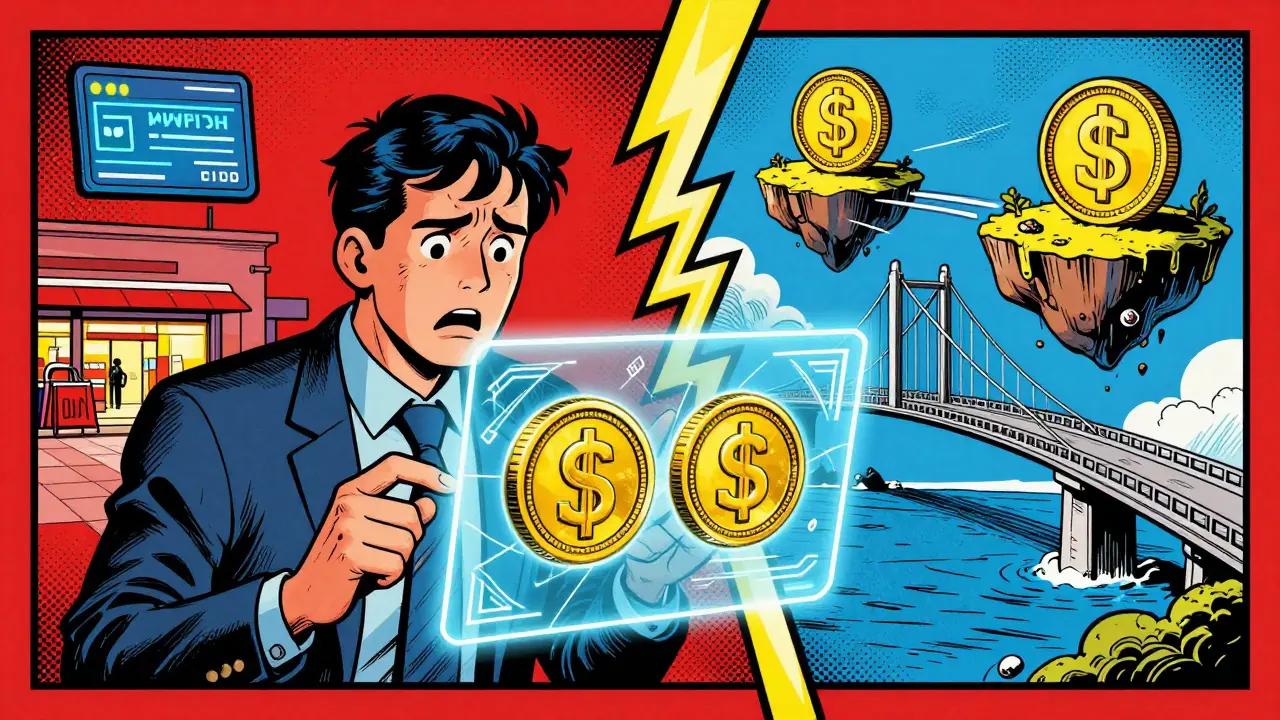
Imagine spending hours researching a coin, finding a great entry point, and hitting 'buy,' only to realize you've invested in a project that has nothing to do with the one you actually wanted. This is exactly what's happening with SWITCH crypto coin, a textbook example of a 'ticker collision.' In the crypto world, the ticker SWITCH isn't unique; it's shared by two completely different projects with different goals, different blockchains, and very different risk profiles. If you're looking at a chart for SWITCH, you aren't looking at one asset-you're looking at two distinct entities fighting for the same label.
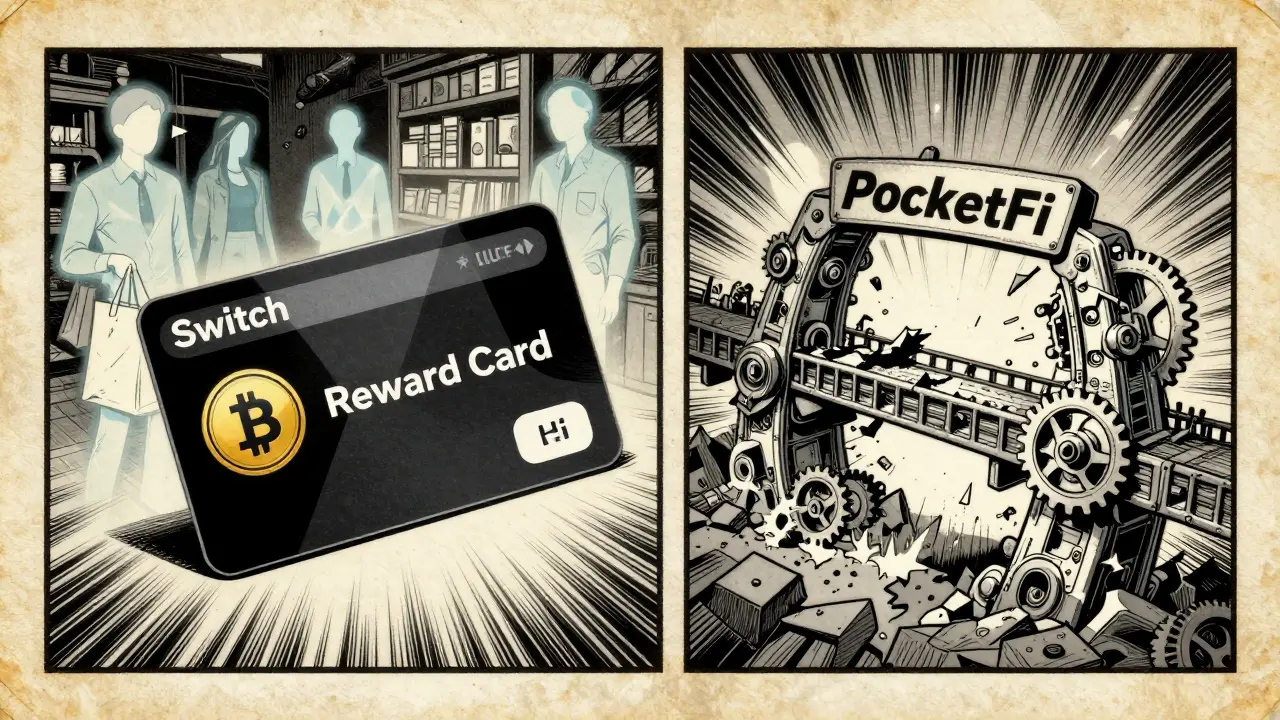
To make sense of this, we need to separate the 'Reward Card' version from the 'PocketFi' version. One is trying to blend traditional shopping with DeFi, while the other is trying to move money between two specific blockchains. Mixing them up isn't just a minor mistake; it's a financial risk because their market caps, liquidity, and actual utility are worlds apart.
The Two Faces of SWITCH
First, let's look at the most prominent one: the Switch Token associated with the Switch Reward Card. This is an ERC-20 token, meaning it lives on the Ethereum blockchain. Launched in early 2023, its main goal is to act as a bridge between Traditional Finance (TradFi) and Decentralized Finance (DeFi) through a B2B service called Switch Pay. As of late 2025, it carries a market cap in the $6 million range, with a massive circulating supply of over 45 billion tokens.
Then there is the second version: the PocketFi SWITCH token. This project isn't about reward cards; it's a retail interface designed for on-chain trading. Specifically, it acts as a bridge between the Solana and TON (Telegram Open Network) blockchains. This version of SWITCH is much smaller, with a market cap under $300,000, and was distributed primarily through in-app mining that ended in March 2025.
| Feature | Switch Reward Card (SWITCH) | PocketFi (SWITCH) |
|---|---|---|
| Blockchain | Ethereum (ERC-20) | Solana / TON |
| Primary Purpose | B2B Payments & Rewards | Cross-chain Trading Bridge |
| Market Cap | ~$6.85 Million | ~$237.68 Thousand |
| Circulating Supply | 45.76 Billion | 1.36 Billion |
| Primary Access | Uniswap / Tokpie | PocketFi App |
Technical Realities and Red Flags
When you look under the hood, both projects show some worrying signs. For the Switch Reward Card token, the technical setup is a standard Ethereum contract (address 0xb10cc888cb2cce7036f4c7ecad8a57da16161338). However, the numbers don't tell a great story. With 92% of the 50 billion max supply already in circulation, there is immense downward pressure on the price. Even worse, liquidity is ghost-town level. A 24-hour trading volume of around $6,000 against a $6 million market cap means that if a few large holders decide to sell, the price could crater instantly because there aren't enough buyers to absorb the shock.
PocketFi faces its own set of problems. While it claims to be a bridge for Solana and TON, critics point out a glaring lack of technical documentation. There is no public whitepaper that explains how the bridge actually works. Many users have reported that the promised TON integration remains non-functional, leaving the token as little more than a reward for people who mined it in an app.
User Experience and Market Sentiment
If you check places like Reddit or Trustpilot, the sentiment is overwhelmingly skeptical. For Switch Reward Card, users have complained about reward payments being delayed for months. There are even documented cases of the payment system failing at major retailers, which is a huge problem for a project claiming to bridge the gap to real-world shopping. Trustpilot ratings hover around a mediocre 3.2/5, often citing a lack of support.
PocketFi isn't doing much better. Their app has been criticized on the Google Play Store for frequent crashes during swaps. For many, the only "win" was the initial 1500% ROI seen by early miners who sold their tokens quickly during the initial price spike. Since then, the project has struggled to find a sustainable use case beyond the app's internal ecosystem.
Expert Ratings: Speculation vs. Value
Professional analysts aren't holding back. Weiss Ratings labeled the Switch Reward Card token as 'Extremely Speculative,' giving it a D+ rating. The core issue is a lack of real-world adoption. While they talk about bridging DeFi, the actual number of active monthly addresses is tiny-under 2,000-compared to the 14,000 registered users they claim. This suggests that a lot of accounts are inactive or perhaps just bots.
From a competitive standpoint, both SWITCH tokens are fighting a losing battle. They are entering a payment and bridge sector dominated by giants like Ripple (XRP) and Stellar (XLM). These established players have millions of active users and clear regulatory pathways. In contrast, the SEC has specifically questioned reward-based token models, putting a target on projects like Switch Reward Card that can't prove they are compliant with financial laws.
The Danger of Centralization
One of the scariest metrics comes from Nansen's blockchain analysis. They found that nearly 80% of the Switch Reward Card's circulating supply moved through just 12 wallet addresses in a single month. In the crypto world, this is a massive red flag. It indicates that a very small group of people (whales) control the vast majority of the token's movement, making the price easy to manipulate and leaving retail investors vulnerable to a "pump and dump" scenario.
Development activity is also drying up. A look at their GitHub repositories shows that commits have dropped significantly. When developers stop pushing code, it's usually a sign that the project is losing momentum or being abandoned. For PocketFi, the reliance on a proprietary app rather than an open-source protocol adds another layer of risk-if the app goes down or the company disappears, your tokens effectively vanish.
Which SWITCH coin is the 'real' one?
Neither is the 'real' one in a global sense; they are two entirely separate projects that happen to use the same ticker. One is an Ethereum-based reward token (Switch Reward Card), and the other is a Solana/TON bridge token (PocketFi). Always check the contract address before buying.
Is it safe to invest in SWITCH?
Both versions of SWITCH are considered high-risk. Analysts have labeled them 'extremely speculative' due to low liquidity, lack of transparent documentation, and high concentration of tokens in a few wallets.
How can I tell the difference between the two tokens on an exchange?
Check the blockchain. If it's an ERC-20 token on Ethereum, it's likely the Switch Reward Card token. If it's associated with the PocketFi app or the Solana/TON ecosystem, it's the PocketFi version. Always verify the contract address against official project sites.
Does SWITCH have any real-world utility?
While Switch Reward Card claims to provide a payment bridge (Switch Pay), user reports and blockchain data suggest very low actual adoption. PocketFi's utility is centered on cross-chain swaps, but reports indicate some of these features are currently non-functional.
What is the risk of 'ticker collision' in crypto?
Ticker collision happens when two projects use the same short name (like SWITCH). This can trick investors into buying the wrong asset or mislead them into thinking a small project is actually a larger, more successful one with a similar name.
Next Steps and Warning Signs
If you already hold either SWITCH token, your first move should be to verify exactly which contract address you are interacting with. For the Reward Card version, ensure you are using the official 0xb10... address in your MetaMask wallet. For PocketFi, keep a close eye on the app's functionality-if swaps stop working, the token's utility disappears.
If you are considering buying in, ask yourself if the risk is worth it. With a high probability of these tokens becoming illiquid within 18 months (according to Delphi Digital), you are essentially gambling on a project with very little institutional support and significant regulatory headwinds. In the current market, sticking to projects with transparent tokenomics and verified GitHub activity is usually the safer bet.
There are 23 Comments
Matthew Wright
This is a classic case of ticker collision... definitely check the contract address every single time!!!
Trish Swanson
Too risky!!! Avoid both!!!
Suvoranjan Mukherjee
Great breakdown of the situation. For those new to the space, always remember that the ticker is just a nickname, while the contract address is the actual DNA of the token. If you're looking at the ERC-20 version, keep an eye on the liquidity depth because slippage can kill your gains instantly in low-volume pairs. It's all about managing the risk-to-reward ratio here!
Siddharth Bhandari
The liquidity on the Ethereum version is indeed concerningly low.
Joshua Aldrich
Man, its crazy how people still fall for this stuff. i mean, if a project doesnt even have a public whitepaper like pocketfi, why are we even talking about it? just feels like another rug pull waiting to happen. honestly, the whole crypto space is just a wild west of ppl trying to scam each other with fancy words like 'bridge' and 'defi' when the tech is barely there. just take a step back and look at the actual utility... or lack thereof in this case.
Susan Wright
Just a heads up for everyone: if you're using MetaMask, you can actually add the verified contract address to your wallet so you don't accidentally swap for the wrong one. It's a lifesaver when dealing with these ticker collisions.
Arwyn Keast
Absolute rubbish. The sheer lack of due diligence in this sector is appalling. We're seeing a systemic failure in basic asset identification, and the retail crowd is just swallowing this sludge. It's purely a speculative bubble driven by low-IQ gambling. Total waste of bandwidth.
Adriana Gurau
Imagine actually thinking these are viable investments 🙄 Honestly, the desperation is showing. 💅
Deepak Prusty
The market cap of $237k for PocketFi is statistically insignificant in a bull market, meaning any small buy could spike the price, but the lack of a whitepaper makes it a zero-value asset from a fundamental perspective.
Earnest Mudzengi
Wake up people! This is exactly how the big banks and the SEC manipulate the flow of information to keep us trapped in these fake assets while they move the real money through hidden backdoors. They create these ticker collisions on purpose to confuse the retail traders so the whales can dump their bags on us. It's all a rigged game designed to keep the US dollar dominant while they suck the liquidity out of every altcoin!
Patty Levino
It's really stressful for people who just wanted to support a project and ended up in the wrong one. Just take your time and double check everything.
Nicholas Whooley
I believe it is important to approach these opportunities with a spirit of caution and mentorship. While the risks are high, learning from these mistakes helps the community grow stronger and more resilient.
Suzanne Robitaille
Oh, the tragedy of a misplaced investment! It's like a digital ghost story where the money simply vanishes into the ether because of a name. Truly heartbreaking for the hopeful souls involved!
Diana Martín Prieto
I can help anyone who is confused about how to check the contract addresses. Just go to Etherscan or Solscan and paste the ID provided in the post to make sure you're looking at the right one. We're all in this together!
Susan Payne
The utter lack of professional standards in these projects is an embarrassment to the financial industry. It is simply unacceptable that such negligence is permitted.
alex rodea
Stay safe everyone.
Emma Pease-Byron
The irony of calling this a 'bridge' when it's essentially a plank over a canyon is not lost on me. How quaint that people still believe in 'reward cards' in 2025.
Erica Mahmood
low liquidity + high whale concentration = recipe for a rug pull. just basic tokenomics 101
Krystal Moore
This is honestly such a scam! How can they just have the same name and not care that people lose money? It's practically stealing!
Sharhonda Walker
i tried to use the reward card and it didnt work at the store.. total waste of time lol
Evan Borisoff
The absolute audacity of these offshore entities to implement such an archaic and flawed identification system is a testament to the lack of oversight in the global crypto market, which is why American-led regulatory frameworks are the only way to ensure that institutional capital doesn't get incinerated by the sheer incompetence of these developers who can't even maintain a basic GitHub repository without seeing a total collapse in commit frequency.
akash temgire
The concentration of 80% supply in 12 wallets is an unacceptable risk factor.
Brooke Herold
It's interesting to see how different regions react to these risks. In some cultures, high-risk speculation is almost a social game, but here it's seen as a disaster.
Write a comment
Your email address will not be published. Required fields are marked *